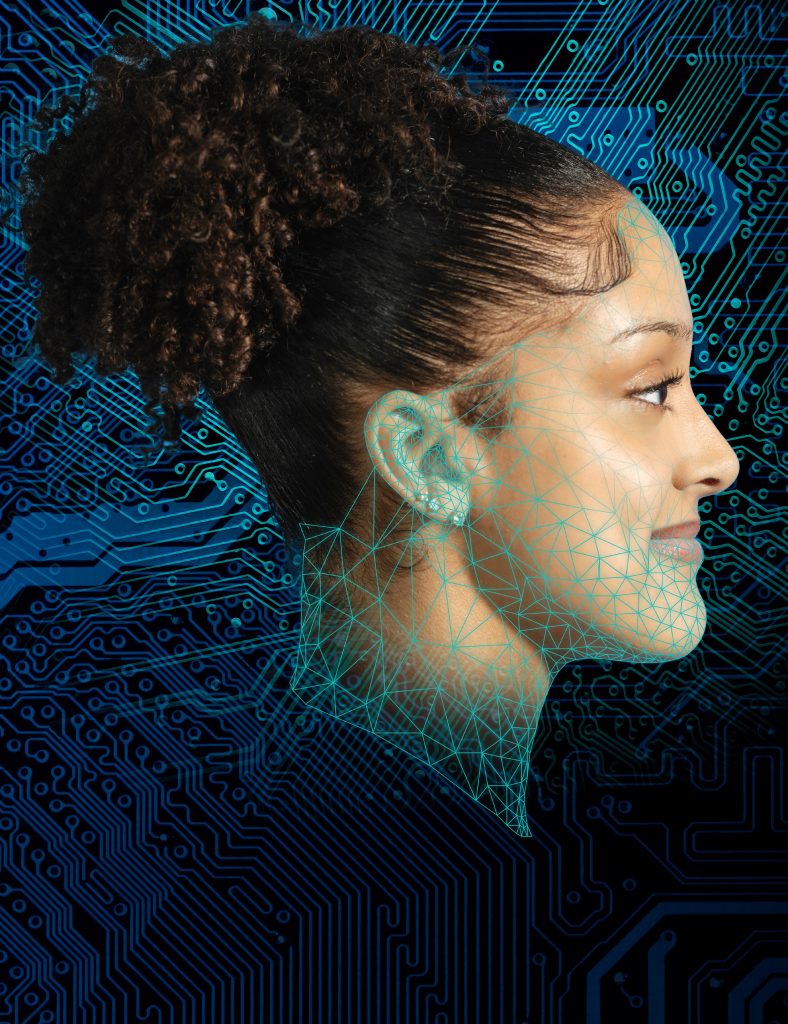
As consumer-level generative artificial intelligence (AI) gained popularity, higher education quickly recognized its potential as a powerful content-creation tool. As a SUNY College of Technology, Canton is expanding its approach to education by integrating AI into learning, research, and innovation to prepare students as it becomes an increasingly large part of numerous industries. In response, some of the College’s faculty members are implementing the new technology in a thoughtful and meaningful way
while adhering to ethical guidelines for its use.
Michelle Burke, an adjunct instructor and high school technology educator from Madrid-Waddington Central, said AI has caused an innovative shift in education.
“A disruptive technology is a new invention or innovation that changes the way consumers, businesses, and education operate,” she said. “It can replace existing systems or habits in a better, measurable way.”
It isn’t the first disruptive technology to alter traditional modes of education. Everything from the invention of the printing press to laptop computers has caused a stir when first introduced. Even the humble slide rule and digital calculator were once considered radical innovations in education that changed the way math was taught and practiced. They also sparked debates over whether they would hinder arithmetic and problem-solving.
“AI is just one more disruptive technology,” she said. “It’s out of the box. Some people want to put it back into the box, but that will never happen.”
Burke, who teaches college courses on drones, presented on generative AI during one of the College’s Microcourse Monday lectures held during the Spring 2025 semester. “AI is not innately good or bad,” Burke said. “It does, however, change the way we look at doing things entirely.”
Her insights reflect a larger trend that was already taking shape at Canton.
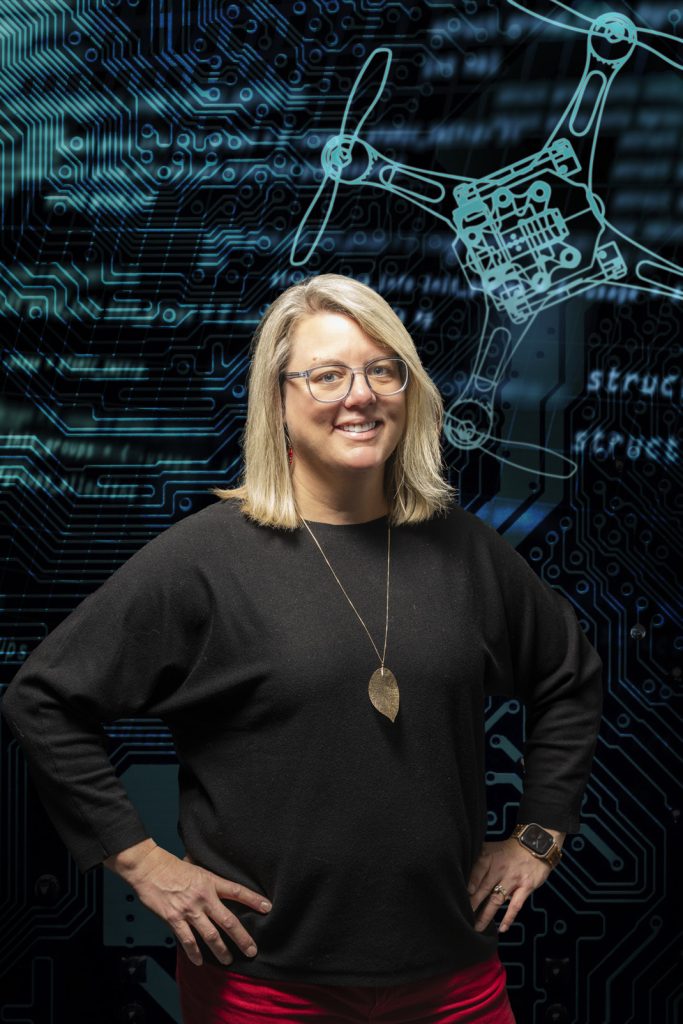
“AI is just one more disruptive technology. It’s out of the box. Some people want to put i back into the box, but that will never happen.” – Michelle Burke
AI in the Classroom
Beginning in 2026, all State University of New York colleges will be required to have an Artificial Intelligence component in their general education curricula. Canton is ahead of the game in teaching AI literacy to students. In English Professor Dr. Eunjyu Yu’s AI and Communication course, students are introduced to the technologies available and the correct usage of those resources.
“The course is designed to help students advance their AI literacy and learn to use chatbots responsibly and creatively and eventually craft their distinctive voice rather than being passive AI users,” Yu said, explaining that chatbots are a type of AI using a large language model to generate human-like content. “They design and produce documents according to professional parameters.”
She explained that students analyze AI interactions through a humanistic lens and apply research skills to
delve into the ethical and legal dimensions of generative AI, including chatbots’ hallucinations, bias, data privacy, and copyright status.
Yu is one of the School of Business and Liberal Arts’ most published researchers. In 2023, she studied the impact of three AI applications on students in one of her online classes. She published “Intelligent Enough? Artificial Intelligence for Online Learners” in the Journal of Educators Online.
“Evidence showed us that high-performing students felt comfortable using AI to improve their writing skills and asserted that AI-generated feedback enhanced their metacognitive skills and autonomy,” Yu said.
She noted that while there was an extensive focus on generative AI, including OpenAI’s ChatGPT, students were already using AI applications, including Grammarly, SafeAssign and PackBack, to improve their unique writing styles.
“Good writing is creating the best presentation of your idea,” she said. “Good writing requires essentials and something special, just like a delicious dish made out of a secret recipe. Based on a recipe, AI could quickly help you find the essentials. But don’t let algorithms over-season your voice. It should be you who creates a unique signature dish with handpicked ingredients so you can take ownership of it.”
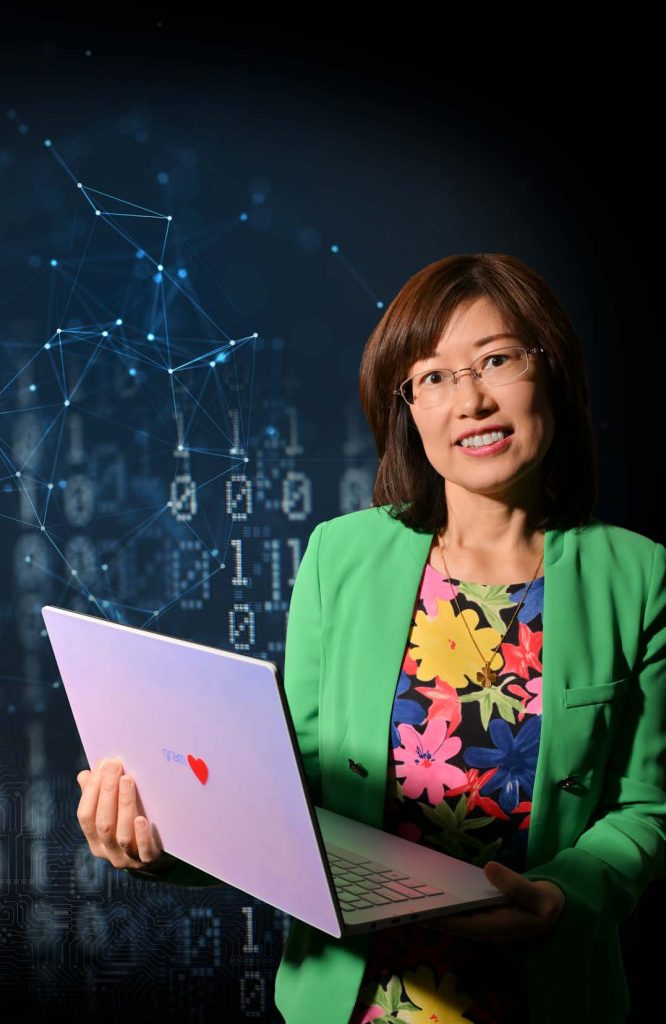
“The course is designed to help students advance their AI literacy and learn to use chatbots responsibly and creatively and eventually craft their distinctive voice rather than being passive AI users.”
– Dr. Eunjyu Yu
Big Data for Business
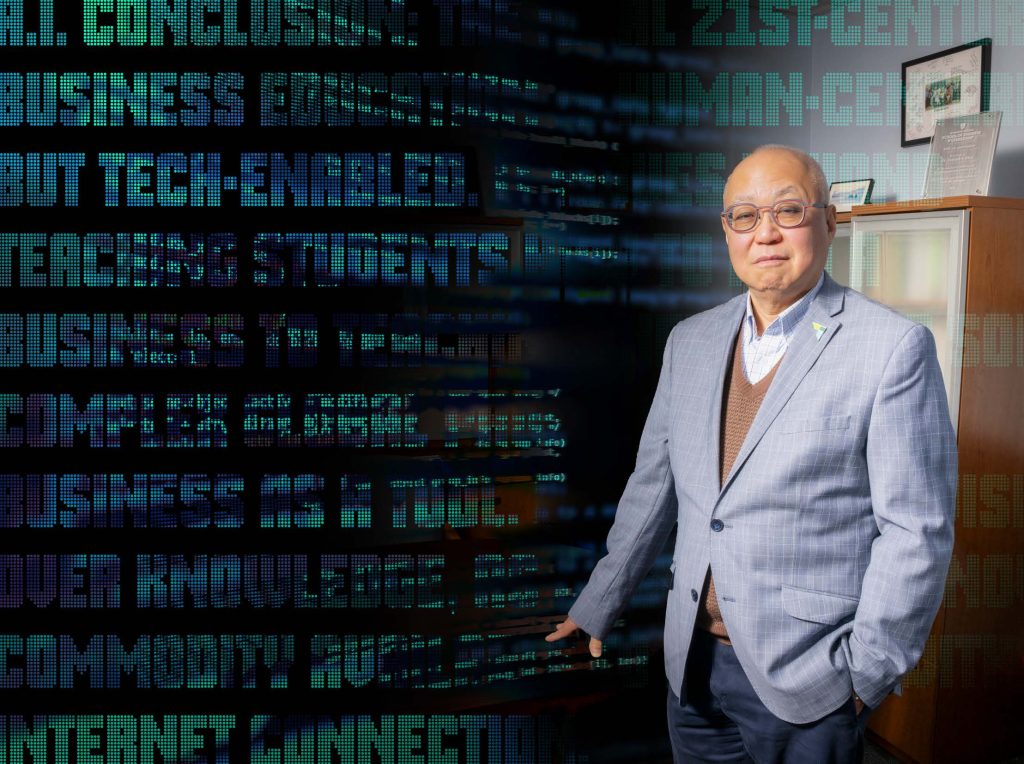
School of Business and Liberal Arts Dean Dr. Kenneth Rhee asserts that business education has not kept up with the rapid changes in the competitive business environment. “It’s time for business education to undergo a radical transformation to meet the demands of the 21st century,” the Dean said.
Some educators fear students using large-language models to write their academic papers or research, which upsets tried-and-true practices of educational methods. Where others may see problems, Rhee sees opportunities to personalize education with AI.
“The future of education will be highly customized, with AI assistants helping students learn and prepare for class,” Rhee said. “Class time will focus on discussions and experiential activities as the traditional lecture format becomes less relevant.”
A key aspect of the digital revolution is the emergence of big data. The term refers to large and complex datasets that are not easily managed, processed, or analyzed using traditional data processing methods. It is often used to uncover patterns, trends, and associations, particularly in human behavior, business operations, and technology.
While businesses have always relied on data to guide their decisions, the volume and variety of data in the 21st century have expanded significantly. Technologies such as big data analytics, artificial intelligence, and machine learning are now routinely used to predict trends, customize customer experiences, and enhance operational efficiency.
Coincidentally, the College has already created a program encompassing the new technology in addition to implementing large language models, generative AI and machine learning within its hands-on career-driven courses.
Preparing Students for AI Careers
The College recently announced a new Data Science and Analytics program (Page 4). Developed as an offshoot of the highly successful Cybersecurity program within the School of Science, Health, and Criminal Justice, the program teaches students how to develop and use AI in
professional applications.
“Graduates will have a wide range of career opportunities, including roles as data scientists, AI engineers, machine-learning engineers, and even business analysts, depending on the industry and project needs,” said Assistant Professor Dr. Mehdi Ghayoumi. “We don’t just try to prepare students for the future; we actively do it to ensure they graduate with the skills needed to lead in the AI-driven world.”
Ghayoumi serves as the lead faculty member for the program and is the author of three books in the field of artificial intelligence, covering applied deep learning, generative AI, and the mathematical foundations that underpin machine-learning models (more on Page 22).
“The curriculum includes courses in large-language models, natural-language processing, and modern machine-learning, with applications in areas such as cybersecurity and digital health,” the Assistant Professor said. “Students begin with algorithmic foundations and go on to develop hands on projects. These might include text data analysis, smart health monitoring, cyber threat detection, or AI systems
tailored to their interests.”
The program is just in time to train a new generation of techsavvy employees. According to the latest LinkedIn statistics, related career fields are among the most in-demand professions today. The U.S. Bureau of Labor Statistics projects 35% growth for data scientists from 2022 to 2032, which is
much faster than average career expansion. The demand is being driven by companies collecting vast amounts of data and needing professionals to extract insights. Graduates will be well-prepared for roles such as data scientists, AI engineers, machine-learning engineers, or data engineers, depending on the industry and project needs.

“We don’t just try to prepare students for the future; we actively do it to ensure they graduate with the skills needed to lead in the AI-driven world.”
– Dr. Mehdi Ghayoumi
Practical Solutions
“AI is not necessarily better or worse than a human being; it’s just a lot quicker.”
– Michael J. Newtown ’84
In an applied example, Canino School of Engineering Technology Dean Michael J. Newtown ’84 is using AI to solve practical problems. Newtown was teaching an Electrical lab where students needed to create code that would allow an Arduino computer chip to communicate with a temperature-controlled device called a thermistor.
“Thermistors are nothing more than specialized resistors,”
Newtown said. “Understanding how they react to temperature is key in automation.”
The problem was that the two technologies weren’t speaking to one another. “I told a student to open ChatGPT and type in ‘I want to sync my LM870 thermistor to an Arduino,’ and it spat out the code we needed two minutes later,” Newtown said. “Everything worked great.”
Without this technology, the students would have still
come to a solution, but it would have taken them a lot
more time. “AI is not necessarily better or worse than a
human being; it’s just a lot quicker,” he said.
In this case, the object of the lesson wasn’t about creating
the code for the project; it was about the result. The
Dean surmised that AI-enhanced learning, rapid problem-solving in technical education, and the blend of theory and industry practice, in conjunction with tried-and-true practices and modern tools, are reshaping both classrooms and careers.

Solutions for Students
Two new employees have become the newest AI ambassadors at the College. Associate Professor and Business Department Chair Dawn Robinson, Ph.D., and TRiO Director Andrea Robinson both use a variety of platforms to brainstorm and conceptualize new ideas. Following their own AI research, they suggested teaching with AI rather than against AI approach.
Dawn uses AI to enhance teaching, curriculum design, and professional work by generating ideas, drafting outlines, and exploring real-world examples that connect theory to practice. It also supports her work in leadership, program development, and community-engaged learning by helping her think more creatively and efficiently.
“AI is a powerful learning partner, not a shortcut,” Dawn said. “It can help you organize your thoughts, clarify complex ideas, and develop outlines or starting points, but your critical thinking, voice, and judgment should always lead the work. Used thoughtfully, AI can support learning rather than replace it. AI is a starting point, but never the end product.”
Andrea suggested students get the most from AI when they use it to ask better questions, explore multiple perspectives, and refine their understanding of course material. “Treating AI like a tutor or brainstorming partner, rather than an answer machine, helps deepen comprehension and supports ethical academic practice,” she said.
Both pointed to an emerging “balanced” model where students are permitted to use some AI for learning while requiring transparency on how and why it was used. The overall thinking process determines grades, so students can benefit from the resource while still being accountable for their own mastery.
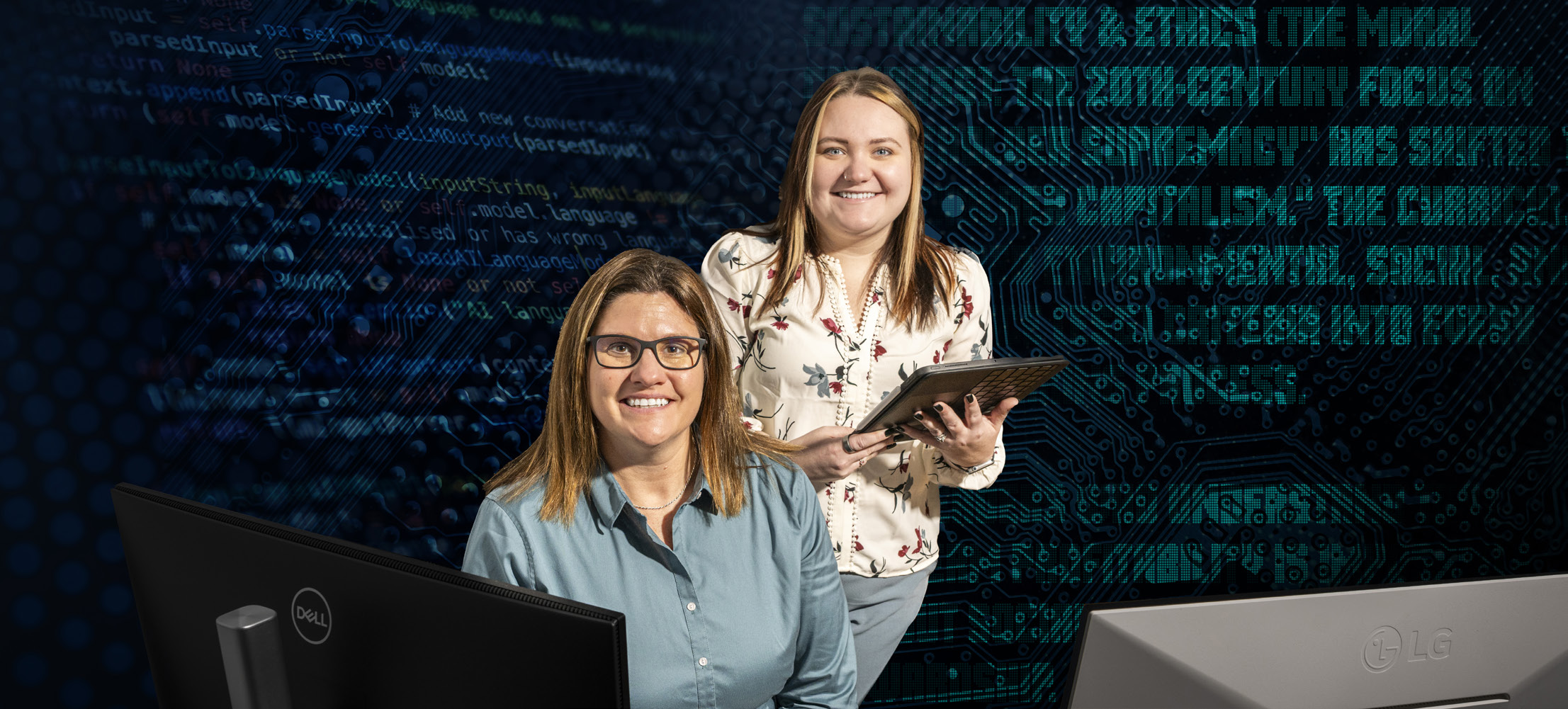
“Treating AI like a tutor or brainstorming partner, rather than an answer machine, helps deepen comprehension and supports ethical academic practice.”
– Andrea Robinson
Challenges and Opportunities

Faculty are exploring how AI can enhance coursework, while students are increasingly encouraged to leverage its abilities for problem-solving and creative projects. Canton is also committed to addressing the ethical implications of AI, ensuring students develop critical thinking skills alongside technical proficiency. By embracing this technology, the College prepares graduates for an evolving workforce where AI literacy is increasingly essential. As AI continues to evolve, Canton remains committed to adapting to it–ensuring students are not just prepared for the future but equipped to shape it.
Author’s note: If the preceding paragraph reads differently than the rest of the piece, it’s because it was a response to a ChatGPT prompt guided and edited by the very human author of this article.
Cybersecurity Faculty Member Pens Book on AI
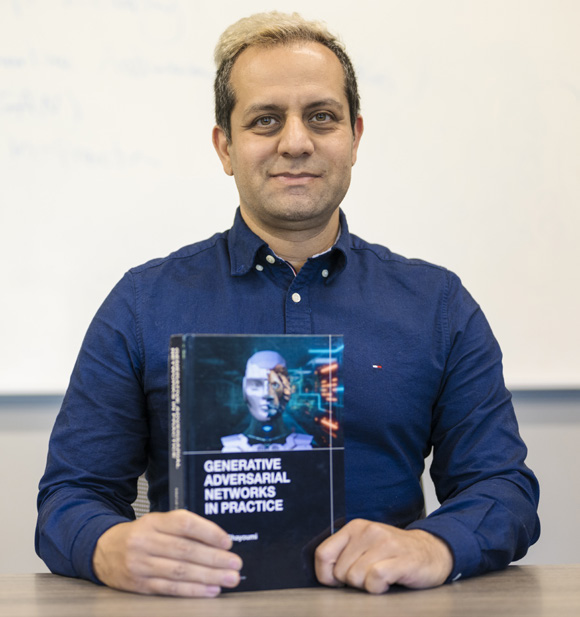
Assistant Professor of Cybersecurity Dr. Mehdi Ghayoumi has published a book that reveals the intricate programming behind generative artificial intelligence (AI) platforms.
His book, “Generative Adversarial Networks in Practice” offers an in-depth exploration of generative adversarial networks (GANs), blending foundational theory and practical applications.
“It’s designed to help readers understand and implement GANs,” he said. “It provides a detailed explanation of GAN approaches and their implementation on popular deep learning platforms, highlighting practical advancements and real-world applications.”
College Debuts Cybersecurity, AI, and Data Science Microcredentials

In order to keep pace with emerging technology, the College has developed several high-tech microcredentials that allow targeted study in artificial intelligence, data mining, data science, deep learning, and ethics and privacy in data science. In addition, a microcredential related to AI and Communication is designed for anyone looking to increase their AI literacy and understand its ethical and legal implications.
Created primarily for professionals who want to change careers or upskill in their chosen field, microcredentials are intended to be completed in months, not years. All tracks range from 6 to 9 credits and can be earned online. Current students enrolled in a bachelor’s program can also apply a microcredential toward their degree.