
Sri Lanka’s children with speech, hearing and swallowing disorders have a universal health care system that lets a team of different specialists assess their needs, offer therapies and train their parents to care for their family member with special needs.
The lesson in one-stop-shopping for clinical care in a third world country was a real eye opener for Rachel King ’15, M ’17, a SUNY Cortland
Communication Disorders and Sciences Department lecturer, who has a B.S. in speech and hearing science and an M.S. in communication sciences and disorders.
“But unfortunately, at this clinic they have 15,000 children registered,” she said of clients from this Indian Ocean island nation poised off the southern-most tip of India. “There are five speech therapists, and also students who work there, so even children who are quite severe don’t see a specialist very often.”
American children usually receive much more frequent therapy through the services offered right in their schools or private clinics. In Sri Lanka, children may only see a specialist once a month or even only once a year, so they make it count.
“We always collaborate in the United States but seeing how this clinic comes together through occupational therapy, physical therapy, speech therapies, and audiology, this clinic is so interwoven and they’re having continuous meetings all the time about the children who come in,” King said. “They’re very client-centered.
King had accompanied Sri Lanka native and SUNY Cortland associate professor Nimisha Muttiah on a new two-week course, “A Clinical and Cultural Experience in Sri Lanka,” during January’s trip involving a 14-hour flight.
Upon arrival, the eight graduate students and four undergraduates, 11 from SUNY Cortland and one University at Buffalo participant, spent seven days working closely from 7 a.m. to 5 p.m. with their south Asian counterparts in the busy Ayati National Centre for Children with Disabilities. They engaged in the novel experience of trying out their professional skills in an under-resourced, multicultural environment where much was done very differently than in the U.S.
The course appears to be among only a few international clinical experiences offered by American colleges and universities in the discipline, as the program’s time demands on students tend to crowd out study abroad opportunities.
“It’s very rare for any study abroad opportunities to occur within my discipline unless you’re involved in some kind of outreach, or if you’re a traveling speech pathologist,” King said.
During high school she experienced family and church trips overseas taking her to Jamaica, Dominican Republic and Haiti, but until now she hasn’t been able to grow and learn in her profession while abroad.
King joined her alma mater in Fall 2021 as a clinical educator and lecturer. She supervises graduate-level clinicians in SUNY Cortland’s Center for Speech, Language and Hearing Disorders and in community clinic placements as they practice assessment and treatment methods within the speech-language pathology scope of practice for the first time. King teaches undergraduate and graduate-level courses at the university, including Normal Language Development, Cleft Palate and Craniofacial Disorders and Phonology and Articulation Disorders.
Previously, she had served two years as a clinical specialist at Dryden Elementary School and five years at Guthrie Cortland Medical Center.
“Swallowing disorders is a common area within our field, but working with pediatric swallowing disorders is a specialty within itself,” said King. “And that’s the area that I primarily focused on when I was in Sri Lanka.”
“Also, this is an area that our students don’t get to focus on very often because it’s a specialty within our field.”
During the trip, King offered a clinic in her specialty that was attended by about 100 Sri Lanka clinicians in person and virtually.
“This area (pediatric swallowing disorders) is a little new for them in Sri Lanka, so I think that they appreciated learning how we would go about clinical assessment,” King said.
“We also spent a lot of time with parents. We do parent training here in the U.S., but that would be through therapy,” King said. “But (in Sri Lanka) if they weren’t going to be back in another month, we really have to spend the time during the evaluation also to provide that parent education on feeding techniques, safety precautions, positioning and compensatory strategies that they could use. We had to make sure they are well equipped to follow through with those things when they went home.”
She described one case where the parents had been unable to get their child with autism to eat a broad diet.
“This child was only eating probably three very plain items,” King said. “He wouldn’t try different textures, or different tastes. Even the items that he was eating, he had brand preferences and he wouldn’t expand on those.
“When we opened a new food in front of the child, he immediately started screaming at the top of his lungs, indicating clear aversion. The parents closed up the food container and we tried play-based therapy.”
In a single session, King used a fish hand puppet to progressively calm the child and some of his fears.
“The first step might be that the client is just in the same room as the food, then come close to it, then be willing to touch it,” she said. “It’s often a slow, steady progression.”
They used the puppet fish to gradually explore the food, going near it and finally being willing to eat it
The child moved closer and slowly became willing to engage with it — eventually sniffing and tasting it.
“The parents were in tears,” King said, explaining that she offered the parents instructions for home. “They just couldn’t believe how quickly this was working. … That was an impactful experience.”
King hopes the course leaves a deep mark on the class, whose members were able to, for perhaps the first time, work with children with severe communication (Muttiah’s specialty) and swallowing disorders.
She has advice for current Red Dragons in the discipline:
“All of the hard work that you’re doing in the clinic is going to get you prepared for practice,” King said. “And even though it’s hard now, you’re going to be so happy that you put in the work because of the people that you will help, and the lives that you will touch, and how meaningful your future career will be. It’s worth it; I truly mean that with all my heart.”
The experience also helped graduate clinicians broaden their understanding of cultural difference. For example, Sri Lankan families must deal with stigma due to their Buddhist tradition.
“Maybe in a previous life you had done something wrong and so your child having a disability is kind of your burden to bear because of karma,” King said. “And so, helping the parents through that is another aspect of counseling that we incorporated.”
King and several students with the American group said language wasn’t a barrier because half of the population spoke English along with their native Sinhala and Tamil and the clinic’s Sri Lankan speech therapists were ready to step in and translate.
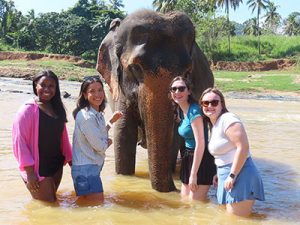
The class spent several leisure days — observing a solemn Buddhist temple ceremony and visiting a baby elephant orphanage, a sea turtle rehab clinic, verdant formal gardens and the sunny seaside near the city of Kandy.
While there, the students also raised $2,000 from among friends and family back home to help a tiny rural clinic serving children with autism that was severely flood damaged by a recent typhoon. The future clinicians and educators also left behind therapeutic toys they had purposely brought along on the trip.
This was the pilot offering for the new course. Muttiah worked with her department chair, Associate Professor Deborah Sharp, and the university’s International Programs Office, to set up the study abroad offering and her family helped with many logistical aspects of the itinerary.
A second SUNY Cortland trip in 2027 is possible.
IMAGES:
FIRST: Supervising as two students practice therapy in a swallow clinic are a speech therapist from Sri Lanka’s Ayati National Centre for Children with Disabilities, standing on the left, and Rachel King ’15, M ’17, standing on the right.
SECOND: During her swallow clinic in Sri Lanka’s Ayati National Centre for Children with Disabilities, Rachel models a tongue movement, encouraging the child to imitate in order to assess range of motion, as she performs a clinical swallowing evaluation with two students.
THIRD: The American group stands with clinicians at the Ayati National Centre for Children with Disabilities. Rachel King is standing in the front in a long flowered dress.
FOURTH: Four American students who are future communication disorders and sciences professionals relax at a rescue facility for orphan elephants in Kandy, Sri Lanka.