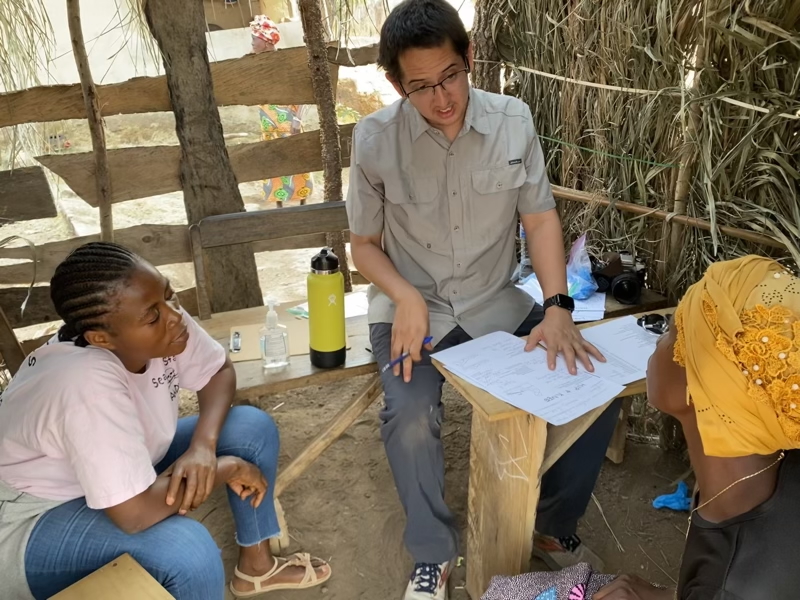
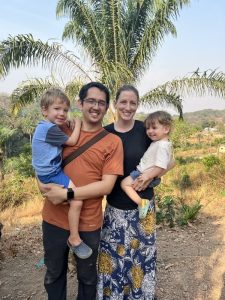
For the past five years, my wife, Rachel, and I, along with our two young children, have served at Waterloo Hospital in Waterloo, Sierra Leone. Sierra Leone is a coastal country in West Africa and one of the least developed nations worldwide. Waterloo is located in the Western Area region and serves as a vital infrastructure link between Sierra Leone’s capital, Freetown, and the rest of the country.
Sadly, many Sierra Leoneans lack access to reliable healthcare. As a result, Waterloo Hospital, a facility with over 40 beds and an adjoining clinic, is an essential resource for its community.
I am the medical director of the hospital and am passionate about training our advanced practitioners and providing staff development. Rachel is a physician assistant and rounds on pediatric wards, manages outpatients, and runs the hospital’s sickle cell program. Moving to Africa and adapting to a new culture has broadened our understanding of the body of Christ. This perspective has shaped our view of what it truly means to do God’s work.
For me, I’ve found that the concepts of physiology and pathology help me understand the body of Christ. There are so many things about the human body that I simply don’t understand. For example, embryology or the complement system are beyond my grasp, yet they are spectacular. The dance of hormones, signals, and cells that are required to weave together life or protect against infection is truly marvelous. However, this system can also be thrown into disarray, resulting in a disease that is complex, terrible, and potentially untreatable, with no solution on this Earth. When I think about the human body, it’s a cacophony of both beauty and terror, potential and suffering—a miraculous beauty marred by generations of sin. The body of Christ is also complex.
We had a patient with hyperemesis gravidarum admitted to the hospital. She spent more than five days almost constantly vomiting into a bucket. We tried every antiemetic medication we had, to no avail. Her retching sounds and vomiting became part of the background noise for the hospital. I felt so bad for her. But as she was paying her bill at discharge, she said, “Please take this $50 for that other patient’s bill. They are suffering more than I am.” She gave three weeks’ worth of minimum wage to someone because even in her own pain, she could see the suffering of others. I don’t know if the woman was Christian or not. But to me, she is the body of Christ.
Our security guard’s 8-year-old son was bitten by a dog over six months ago. They immediately traveled to the capital and received all available rabies shots from the government. The puncture wounds healed well. Two weeks ago, though, they came to us saying the boy couldn’t swallow. He had hydrophobia, paroxysmal contractions of the pharynx, and the final stage of human rabies infection. We discovered that the government hadn’t had the rabies immunoglobulin that the boy needed six months prior. We watched him die over the next week as the rabies virus took over his brain, knowing there was nothing we could do. At the funeral, everyone—both implicitly and explicitly—said, “Don’t worry, the rabies virus killing your child is God’s will.” Hospital staff said, “Maybe it’s time to have another child.” People asked the mother, “Why did you let your son go near a dog?” Unfortunately, this is also the body of Christ. It’s not a healthy part, but a part nonetheless.
One of the triage nurses at the hospital, Fatima, is a single mother and the sole breadwinner for her family. She earns about $5 a day in a country where a can of baby formula costs $10. Two months ago, she went to the market, and a complete stranger stopped her: “Can you hold my baby for a second while I go look at something?” The woman never returned. Fatima decided to adopt the infant, even though Fatima’s salary will barely cover the child’s feeding expenses. She continues to have faith that God will provide. Fatima is unquestionably the hands of Christ.
I met an evangelist working in the far North of Sierra Leone. Previously, he was the head witch doctor for the region around his hometown. “Nobody could have succeeded in any rituals unless I was there.” He told me how deep the darkness runs in this country. He said, “At the peak of my connection with the spirits, I could bring down rain in the height of dry season if you gave me three children to sacrifice.” But through local evangelists who were supported from abroad, he eventually gave his life to Christ and joined the evangelistic effort. The threats to the body of Christ within Sierra Leone are both real and challenging.
The body of Christ is everywhere. It spans the whole globe, including Waterloo. Sometimes, the body aches and stumbles; sometimes, it is vibrant and reaching outward. I am daily encouraged as I witness the body coming together in the form of hymnals given for our local SDA church, an X-ray machine purchased by a quiet donor, and a community stepping up for one another. God’s work is not bound by time, place, denomination, or magnitude. It encompasses everything from the largest institutions to the smallest individual donation. In Sierra Leone, the body of Christ is real—sometimes broken, always growing, and never alone.