
From Teaching to Telling Our Stories: Dr. Nancy S. Lind’s (’80) Legacy of Education, Writing, and Public Service
By Kim Westerman | March 2026
When Dr. Nancy S. Lind talks about Stev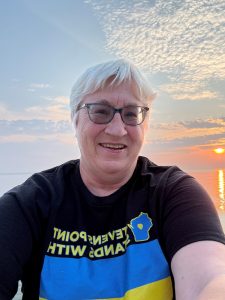 ens Point, she does so not as a nostalgic observer peering back through time, but as someone who has carried the place with her — intellectually, ethically, and emotionally — for more than four decades.
Lind graduated from UWSP with a triple major in political science, social science, and public administration in 1980. She says, “Stevens Point was a campus where professors knew their students well, and intellectual curiosity was cultivated through close mentorship.” Lind thrived in that environment, receiving the Chancellor’s Leadership Award and the Albertson Medallion as a student — early recognition of a voice that would eventually reach far beyond the classroom.
After graduating, Lind carried that ethos into a long and distinguished academic career at Illinois State University, where she served as Professor of Politics and Government from 1985 to 2021. Her excellence as a teacher was recognized nationally when she was named a CASE Professor of the Year finalist in 2004 and received Illinois State University’s Outstanding Teacher Award. Her teaching style has always emphasized honesty, humility, and storytelling. She says, “If a lecture failed, I said so. If theory felt abstract, I tried to anchor it in real-life examples.” “Students,” she says, “learn best when they feel seen, and when ideas are tied to real human consequences.”
She recalls that, “At UWSP, the relationships formed were just as influential as the coursework.” Lind remembers professors who challenged her, supported her, and treated students as emerging colleagues rather than passive recipients of information. That model — education as dialogue, not distance — became foundational to her own teaching philosophy and later, to her writing.
One of Lind’s most enduring memories reflects that belief. While teaching in a graduate Peace Corps development program, she welcomed a high school dropout — brought to class by a former Peace Corps volunteer — into a graduate seminar. Rather than treating him as an outsider, Lind invited his perspective. That moment helped set him on a new educational path, one that eventually led to college and a master’s degree. For Lind, it was a reminder that education happens wherever curiosity is invited to the table.
Her return to Stevens Point in 2020 was driven by family circumstances during the early months of the COVID-19 pandemic. What was meant to be temporary became permanent after the death of her father and the ongoing care needs of her mother. Lind retired from Illinois State University earlier than planned, but she did not step away from her purpose. Instead, she redirected it. The move was a homecoming in the fullest sense: a return that highlighted new skills, different questions, and carried a renewed sense of civic responsibility back to the community where she grew up.
In a new incarnation of her career, Lind emerged as a storyteller, a civic advocate, and an educator whose classroom had simply expanded beyond university walls. Her work today — spanning local journalism, nonprofit leadership, and an ambitious body of writing — reflects a throughline that has guided her entire career: education as a public act, rooted in people, place, and lived experience.
Drawing on decades of experience in public administration and nonprofit management, Lind launched a nonprofit management consultancy in 2022. She offers her services pro bono to organizations with connections to Portage County, helping with strategic planning, governance, grant writing, and crisis response. Her work with groups such as the Humane Society of Portage County and Monroe House reflects the same commitment she brought to teaching: strengthening institutions so they can better serve people.
One of her most meaningful nonprofit engagements has been with Girl Power Africa, an organization that supports education and healthcare access in Liberia. The group’s founder, Bulleh Bablitch-Norkeh, has deep, little-known ties to Stevens Point through her father, the late William Bablitch, a former Wisconsin Supreme Court justice and state senator. For Lind, the connection exemplifies how local histories intersect with global impact — a theme that runs through much of her writing.
In 2025, Lind’s post-classroom impact received international recognition when she was honored with the Global Recognition Award, celebrating four decades of academic excellence and transformative nonprofit leadership. Evaluated by an independent panel of industry experts using the Rasch model measurement scale, the award acknowledged her strategic nonprofit consulting and global community empowerment work, including initiatives with international reach. The recognition underscored how Lind’s lifelong commitment to education has translated into measurable public and global impact.
It’s perhaps not surprising that writing has become the most visible expression of Lind’s recent work. Freed from the constraints of academic publishing, she has embraced a wide-ranging creative output that blends scholarship, storytelling, and cultural history. Her recent books include Neighborhoods of Memory: Stevens Point’s Immigrant Communities from Settlement to Cemetery and Behind the Frozen Curtain: Tales from the Heart of Titletown, both published in 2025. These books do not simply catalog facts; they animate them, placing individual lives, neighborhoods, and traditions at the center of Wisconsin’s story.
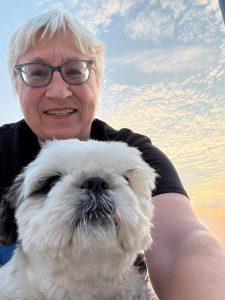 Lind’s writing also extends into fiction and regional mystery, including works set in Door County, as well as books celebrating Green Bay Packers culture. Across genres, her overarching thesis remains consistent: History is most powerful when it is told through people. That same impulse drives her daily Substack, All About The Point, where she reflects on Stevens Point’s past and present — often through personal memory, overlooked figures, and moments that might otherwise disappear.
She has also brought her educator’s rigor to local journalism as a volunteer columnist for the Stevens Point MetroWire. There, Lind engages residents on issues such as zoning, public accountability, and county health services. Her columns ask careful, sometimes uncomfortable questions — not to provoke, but to invite civic engagement. In one widely read piece, she asked whether anyone actually reads legally required public notices, using a simple question to expose larger gaps in democratic participation.
Today, Lind describes her work as guided by responsiveness — following what needs attention, whether that is a nonprofit in crisis, a story waiting to be told, or a civic issue that demands clarity. She remains deeply connected to former students, many of whom supported her return to Wisconsin by helping her move and settle back into the community that shaped her.
The arc of Lind’s story is not one of departure and return so much as continuity. Stevens Point shaped her as a student; she carried those lessons into a long career dedicated to public service and education; and now she brings them home again, enriched by experience. In doing so, Dr. Nancy Lind embodies a rare kind of full-circle narrative — one in which learning never stops.