

Holding the Long View: Justus Paul and a Life of Institutional Stewardship
By Kim Westerman | March 2026

Justus Paul does not talk about his career in grand terms. He speaks instead about people, about moments when institutions choose collaboration over control, and about the responsibility that comes with being entrusted with something meant to last longer than any one person. That perspective shaped his decades at the UWSP and continues to guide his generosity as a donor today.
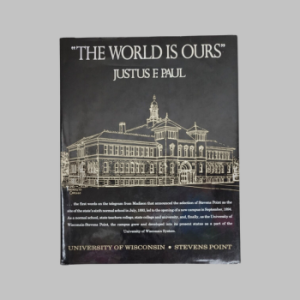
Paul, former Dean of the College of Letters and Science, quite literally wrote the book on UWSP’s history. The World Is Ours, his chronicle of the university’s first 100 years, remains a foundational account of how a regional teachers college grew into a comprehensive university rooted in public purpose. But his deeper legacy lies not only in what he recorded, but in how he lived that history — as a scholar, administrator, mentor, and steward of the university’s values.
A Midwestern Education, Earned the Long Way Around
Born in Missouri and raised across Iowa, North Dakota, and Nebraska, Paul describes himself simply as “from the Midwest.” After earning his undergraduate degree at Doane College, he completed a master’s degree in history at UW–Madison with plans to teach high school. Though he stayed for two years, he knew after about six weeks that this role wasn’t for him.
“I realized pretty quickly,” Paul recalls, “that college students didn’t have to be there. High school students did — and many of them didn’t want to be.” The distinction mattered. It sent him back to graduate school, this time to the University of Nebraska, where he earned a Ph.D. in American history in 1966.
UWSP hired him soon after, a decision Paul still credits as one of the great strokes of fortune in his life. “It was a wonderful place to live, to raise a family, and to teach,” he says. “There was a culture of inquiry. Students were expected to ask questions.”
From Classroom to Administrative Leadership
Paul spent nearly two decades in the History Department, eventually serving as department chair for 17 years. At the time, history was central to the university’s curriculum; all students were required to take American History, and the department once included more than 30 faculty members.
Leadership, for Paul, was never about authority. It was about timing, trust, and responsibility. When the deanship of the College of Letters and Science opened, he recognized another moment to serve. As dean, he became known for a collaborative approach shaped by the example of Chancellor Philip Marshall, whose Quaker belief in consensus left a lasting impression.
“Everyone around the table was asked what they thought,” Paul says. “And depending on what he heard, we either moved forward or went back to think more. That kind of leadership is rare now — but it’s a style we could use more of.”
One of Paul’s proudest moments as dean came in the mid-1980s, when UWSP made an early and decisive investment in computers on campus. Under his leadership, the college ensured that every department — not just those with resources — had access to emerging technology. “We were ahead of most other schools,” he says. “But we were also cautious. Technology should serve learning, not drive it.”
 Writing the University’s Story
As UWSP approached its centennial in the early 1990s, Paul was asked to write the university’s official history. The result, The World Is Ours, is both a scholarly and a richly human book that traces how the institution evolved alongside the state it serves.
Writing the book reinforced Paul’s belief that universities are living systems. They depend on continuity — of memory, values, and people willing to care for them across generations. That belief would later shape his approach to philanthropy.
Giving Back—with Intention
Now retired and living in Green Lake, Wisconsin, Paul remains deeply engaged — with his church, with historical committees, and with the university that defined much of his professional life. His philanthropic support reflects the same philosophy that guided his leadership: thoughtful, mission-driven, and grounded in trust. “I believe in UWSP,” he says simply. “I believe in what it made possible for students, for faculty, and for families like mine.”
To continue paying it forward, in 2008, Justus worked to create the Justus F. and Barbara J. Paul Faculty Endowment with the goal of supporting an outstanding Letters and Science or Library faculty member granted sabbatical.
Paul’s own family story is woven through the university. His late wife, Barbara, worked as a librarian at UWSP. Together, they helped lead a semester-abroad program in Munich, traveling with their children and students — an experience Paul still describes as transformative. He cared for Barbara, prior to her passing, during his early retirement. He speaks of this chapter of his life with quiet devotion.
A Legacy Still Unfolding
When asked whether he would choose the same path again, Paul doesn’t hesitate. “If it were like it was in the 1960s,” he says, “I’d do it all over again.” More than nostalgia, it’s a reminder of what higher education can be when institutions are allowed to thrive: places where inquiry is valued, leadership is shared, and long-term thinking prevails.
Through his years in the history classroom, his writing, his leadership, and his generosity, Justus Paul has strengthened UWSP’s ability to honor its history while investing in its future.