

Dianne Somers (’68): Cultivating Connection Via Land, Learning, and Legacy
By Kim Westerman
When Dianne Somers (’68) talks about leadership, she rarely uses the word itself.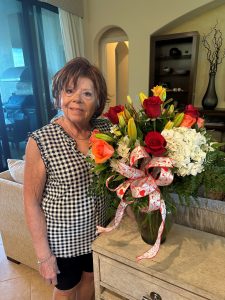 Instead, she speaks about stewardship, collaboration, and showing up—year after year—for the people and institutions that matter. “I’ve always felt that you have to be willing to take part, not just watch things happen,” she says. Her story, rooted in central Wisconsin farmland and shaped by music, education, and advocacy, mirrors the bedrock of the region she has spent a lifetime serving.
Smalltown Childhood
Somers grew up in Hatley, a small community about 25 miles north of Stevens Point. Her mother was a teacher; her father hauled oil and gas for farmers. Gardening was a family constant, and agriculture was not an abstract concept but daily life. One of her earliest memories involves her father handing her a block of wood and a hammer and sending her into the potato fields to get rid of beetles—a small task that reflected a larger lesson about responsibility and contribution.
Music As a First Love
Music, however, was her first passion. Somers began playing piano at age six and continued through high school, accompanying choirs and competing in state contests for both performance and composition. She earned a scholarship to Lawrence University to study music, but the transition from small-town life to an elite conservatory environment proved overwhelming. After leaving Lawrence, she spent a year in Madison studying social work while continuing piano lessons. Encouraged by her teacher, she returned to music, eventually completing her degree at Stevens Point.
After graduation, Somers taught music in the Wisconsin Rapids school system for two years. She got married, had kids, and got more deeply involved in her husband, Nick’s, farm. What began as bookkeeping and administrative support soon evolved into organizational leadership within the agricultural community—during the 1970s, when public perceptions of potatoes and carbohydrates were shifting dramatically.
Shifting Perceptions on Potatoes
As low-carb diet culture took hold, Somers and other growers’ wives recognized that their voices were missing from industry conversations. Together, they formed the Ladies Auxiliary of the Wisconsin Potato and Vegetable Growers Association to advocate for their product and their profession. Under Somers’ leadership, the auxiliary grew to nearly 150 members, coordinated large-scale operations at the Wisconsin State Fair, and became a visible public presence through television, radio, and statewide outreach.
“I remember thinking, if we don’t tell our story, no one else will — and maybe they’ll believe whatever they hear first,” Somers said of those early advocacy days. That belief drove her to forge relationships not just within the farm community but also beyond it.
Collaboration and Communication
Those efforts coincided with rapid advancements in agricultural science. Somers became deeply involved in conversations around sustainability, crop rotation, nutrient management, and water stewardship. Central Wisconsin’s sandy soils and underground aquifers make it ideal for potato production, but also demand careful nutrient control. Over the decades, Somers and her colleagues worked closely with researchers and extension specialists to adopt practices that reduced runoff, protected waterways, and ensured long-term viability.
That collaborative mindset eventually reshaped the relationship between the agricultural community and UW-Stevens Point. For years, the two had operated largely in parallel, despite shared goals. Through dialogue, persistence, and leadership—including Somers’ work alongside then-Chancellor Bernie Patterson—the university and growers found common ground. One of the most visible outcomes was the restoration of the Little Plover River, once blamed on farmers for its decline. Through coordinated research and stewardship, the river was rebuilt and now supports trout once again.
Centering Education for Generations to Come
Another milestone emerged with the opening of the Food + Farm Exploration Center in nearby Plover in 2024. Funded through a combination of grower contributions and major industry donors, the $50-million center welcomes tens of thousands of visitors each year. Designed to show children and families where food comes from, it features interactive exhibits, crop plots, nutrition programming, and partnerships with UW-Stevens Point faculty. Somers and her husband played a central role in fundraising and planning, viewing the center as both an educational investment and a bridge between rural and urban communities.
A Family Legacy of Community Engagement
Somers’ connection to Stevens Point is deeply personal. Her mother attended the university and built a career in education. Somers herself earned her degree there, later serving nine years on the UWSP Foundation Board and continuing today in advisory roles, including the College of Fine Arts. Her philanthropy reflects her life’s dual passions: agriculture and music. She and her family have endowed scholarships in soil science, supporting students like Dan Walsh, a former intern who is now the agronomist at Plover River Farm Alliance, as well as in music and piano performance. Somers says these scholarships were created out of a desire to help other students study music who might not otherwise be able to pursue their craft.
A Crowning Achievement
In recognition of her lifetime of service to the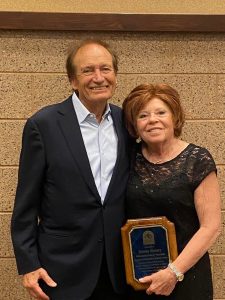 state’s potato industry, Somers was honored in February 2025 with induction into the Wisconsin Potato & Vegetable Growers Association Hall of Fame, one of the industry’s highest honors. The Hall of Fame celebrates individuals whose dedication and impact have shaped Wisconsin’s potato sector, and Somers joins a distinguished list of leaders acknowledged for advancing the industry through advocacy, education, and community collaboration. Her induction highlights not only decades of leadership with the WPVGA and its auxiliary but also years of service on key committees and at major events like the Spud Bowl, which she and her husband helped make a successful fundraiser for UWSP scholarships. To date SpudBowl has provided $44,250 in scholarships to students.
Looking to the Future
Even in recent years, health challenges have not diminished Somers’ commitment. Following treatment for cancer and still in recovery from a stroke, she remains engaged, thoughtful, and forward-looking. She speaks with pride about UWSP’s growth, particularly in the arts, and about the university’s role as one of the twin pillars of the Stevens Point community, alongside agriculture.
When asked what keeps her involved, Somers points not to recognition but to continuity. Education, she believes, is generational. So is stewardship of land, culture, and institutions. Whether through a scholarship, a restored river, or a child discovering how potatoes grow, her work is about ensuring that knowledge and opportunity keep moving forward.
For Somers, legacy is not singular. It is cumulative, built quietly over decades, rooted in service, and sustained by connection. It is the kind of impact that, like good soil, supports everything that grows from it.