

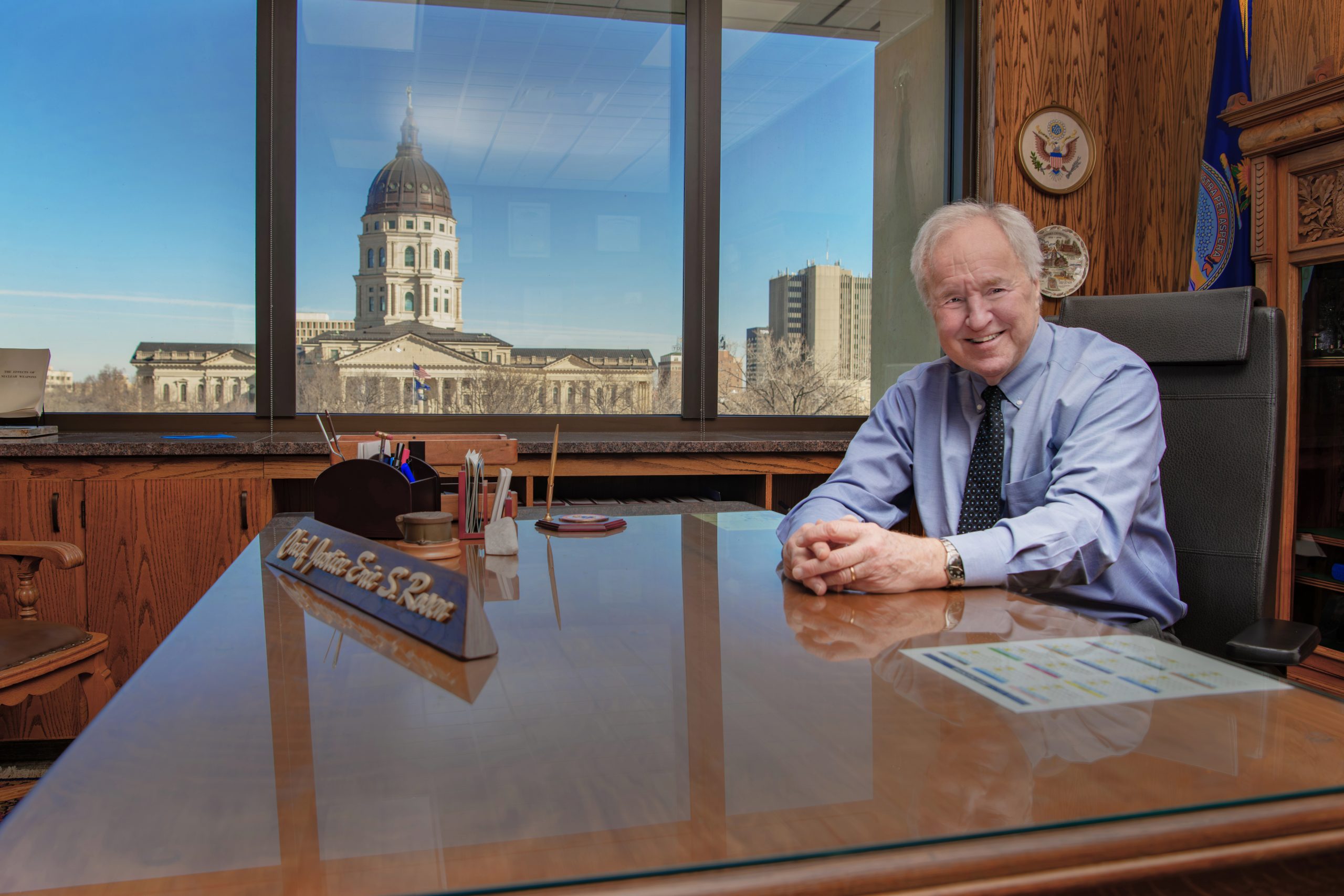
After two decades on the Kansas Supreme Court bench, the Hon. Eric Rosen, jd ’84, was elevated to chief justice in January. His leadership of the state’s highest court is a proud milestone for Kansas and a point of celebration for the Washburn University School of Law community that helped shape his journey.
Long before he wore judicial robes, Eric Rosen was a Topeka native, educated in local public schools and an honors graduate of the University of Kansas with bachelor’s and master’s degrees in social work. He built a career as a school social worker, eventually serving as the department chair for Topeka Public Schools.
For Rosen and his wife, Libby, bsn ’94, life in their late 20s was already full, anchored by two children and established careers. But things shifted when the couple experienced the heartbreak of a stillbirth. Amid their grief, Rosen found himself pausing to consider the bigger picture.
“That was kind of a wake-up call. It made me think about where my life was going,” Rosen said. “I had become disillusioned with my career path, and law school was something I wanted to pursue.”
 He said he encountered both personal and practical roadblocks, but encouragement came from his friend and neighbor, Nancy Maxwell, emeritus professor, who taught law at Washburn and, seeing his potential, urged him to apply. While other institutions were less than accommodating to non-traditional students, Washburn Law was different.
“Most schools insisted you go to school full-time and were pretty rigid about it. Washburn was just the opposite,” Rosen said. “They innovatively addressed the realities of different students’ needs right from the start. It was a very welcoming environment.”
He started law school part-time, but after realizing that it would take him five to six years to complete, he crammed his studies into just over three years while still working half-time, graduating in 1984.
“I was forced to make some very difficult decisions about the allocation of my scarcest and most precious resource, which is my time. I reasoned that while learning was a lifelong process to be continued and expanded long after graduation, my sons would have but one childhood. I wanted to be as involved as possible,” Rosen said. “I had to balance the priorities.”
Washburn Law was more than just a place of academic learning; it was where his passion for public service was forged into a legal career.
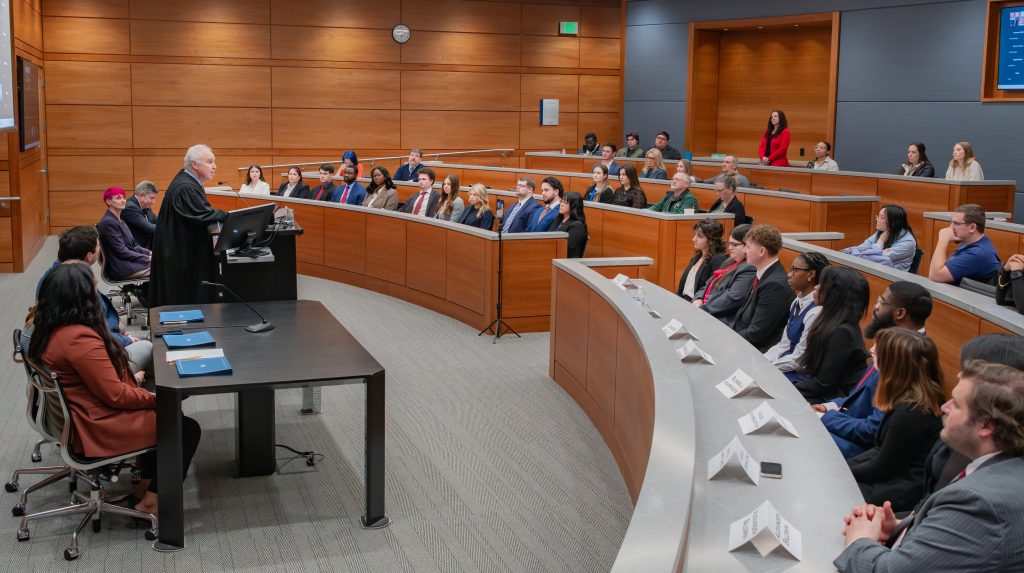 “During my last year, I worked in the Law Clinic and interned at the public defender’s office under Max Rowinsky,” Rosen said. “I was second chair for a second-degree murder trial, and I actually got to participate in the trial. It was an incredible, invaluable experience that resulted in an acquittal for our client.”
He also found mentors in professors who were masters of their subjects and deeply invested in their students. He fondly recalls the influence of individuals like Emeritus Dean and Professor Jim Concannon, h ’24, Emeritus Professor Linda Elrod, ba ’69, jd ’72, Dean Ray Spring, ba ’57, jd ’59, and Emeritus Professor Robert Fowks. They didn’t just teach the substance of civil procedure, domestic relations or criminal law; they modeled the professional responsibility that comes with legal knowledge. They taught him, as he noted in his investiture speech, “to reason carefully, to listen fully and to remember that behind every case are people whose lives will be affected by our decisions.”
This human-centered approach to justice has been a guiding principle throughout his career.
“Everyone at Washburn Law was incredibly supportive, especially my professors. Our third son was born the second semester of my first year, right in the middle of Civil Procedure class,” Rosen said. “Jim Concannon jokingly gave me lots of grief about missing class – appreciation that realities of certain life events can take priority over even one of his brilliant lectures.”
After graduating, Rosen immediately put his Washburn Law education to work for the people of Kansas. He began his legal career with the Shawnee County district attorney, followed by the role of associate general counsel with the Kansas Securities Commissioner office. After a period in private practice in Topeka at the firm of Hein, Ebert and Rosen, his true calling became clear. In 1993, he was appointed to the district court, where he served with distinction for over 12 years. It was there, working side by side with his future Supreme Court colleague, now-retired Chief Justice Marla Luckert, ba ’77, jd ’80, h ’23, that he honed his judicial philosophy.
In 2005, he was elevated to the Kansas Supreme Court. For the next two decades, Rosen became known for his thoughtful deliberation, respect for differing views and his commitment to fairness.
 When Luckert announced her retirement following a stroke, the transition marked the end of an era and the beginning of a new chapter for the Kansas Supreme Court. The Kansas Constitution dictates that the most senior justice would assume the role. For Rosen, the transition was rapid.
“Having the responsibilities of the head of a branch of government isn’t something I had thought about until I assumed them in October – and then the realities started to set in,” Rosen said. “My goal was to keep the judicial branch stable and moving in the direction it had been going.”
In his investiture speech, he emphasized the importance of diversity, respect and shared responsibility within the judiciary. He highlighted how Kansas has always been strengthened by its range of voices and perspectives.
“Our challenge ahead is to preserve the balance diligently achieved and to honor the principles of thoughtful deliberation, respect for differing views and a deep understanding that justice is not static, but something we must continually tend to with humility and care,” Rosen said.
His leadership on the bench is rooted in immense responsibility. As he explained, serving on the Kansas Supreme Court differs in many ways because the legal questions addressed often have a lasting impact, especially when applying constitutional principles.
“The decisions we make don’t just resolve individual cases. They shape the entire areas of the law,” Rosen said. “Increasingly, we’re asked to interpret not only the U.S. Constitution but also our state constitution, identifying distinctions and rights unique to Kansas citizens.”
Rosen’s success is grounded in gratitude – for his family, colleagues, mentors and the educators who shaped him. He carries their influence as he leads the state’s judiciary, dedicated to making justice in Kansas accessible and fair.
“I never aspired to become chief justice, but my experiences at Washburn – interning at the public defender’s office and observing judges like E. Newton Vickers (ba ’49, jd ’50) and others – shaped my path. Presiding over cases, especially in the district court, opened my eyes to the diverse and impactful role of a judge. It’s both challenging and rewarding, and I truly enjoy it.”
Rosen’s career is an inspiring example for Washburn Law students and alumni that a path of service is both honorable and deeply impactful.
“In the grand scheme of things, it’s about holding people accountable while ensuring they can enjoy the rights and liberties guaranteed by our constitution,” Rosen said. “It’s a constant balancing act in everything that we do.”
Chief Justice Rosen and his wife, Libby – recently retired dean of the School of Nursing at Baker University – live in Topeka, where they stay closely connected to their four children and growing family of 10 grandchildren.
