

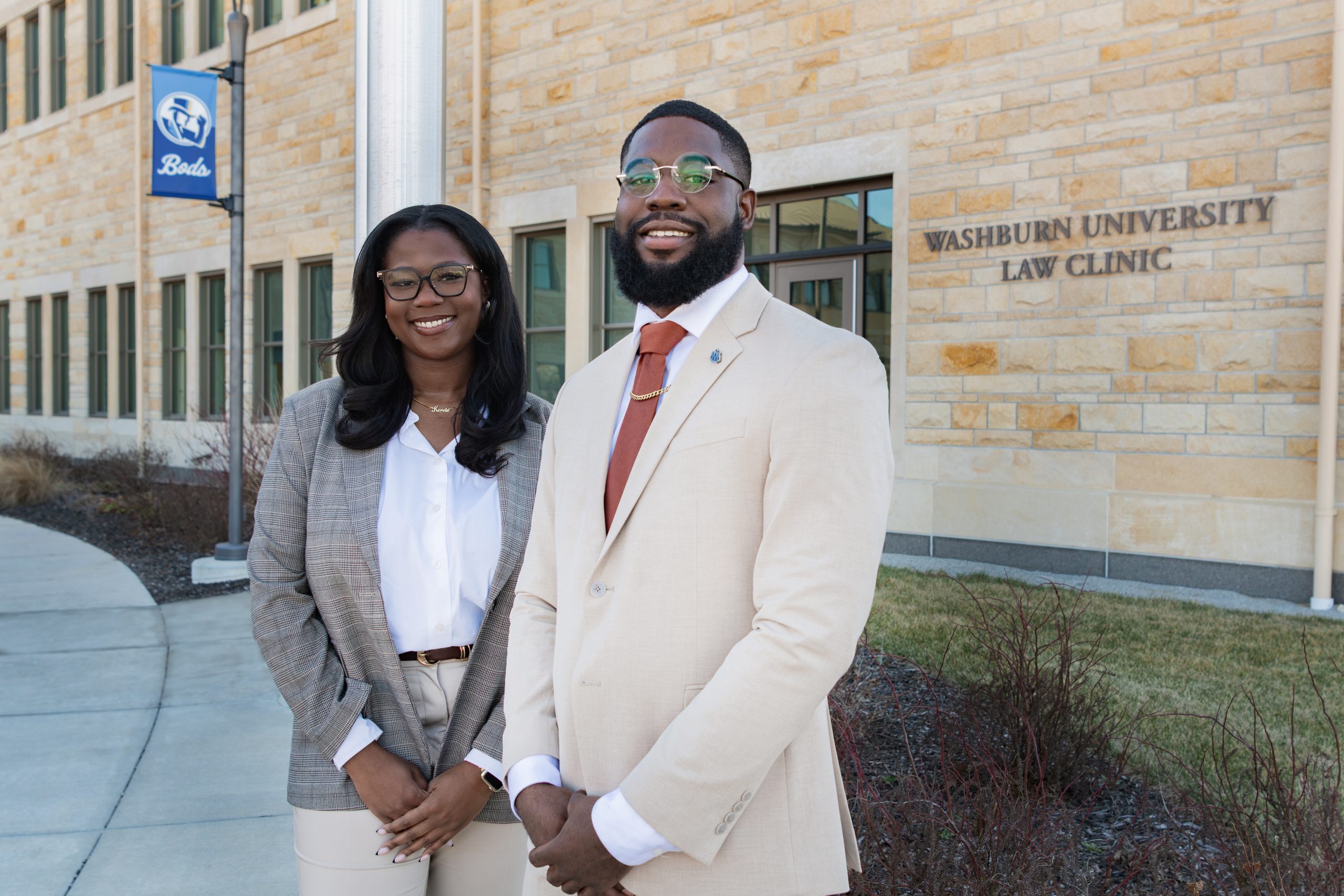
The client didn’t realize it, but Russell Harrison, Rule 715 legal intern, and his partner intern, Kerete Paul, were feeling the pressure during their initial meeting in January.
It was the two interns’ first case for the Washburn Law Clinic – and their first case ever.
“It was hard knowing none of this is scripted, so we really had to be mindful because you don’t get a redo,” Harrison said. “There’s no ‘We’ll show up next week and try again.’”
Now months into their internship, Harrison and Paul are relieved those first waves of nerves are behind them.
“On the first day, I was like, ‘What do I do first?’ But now, that’s not something I have to experience when I graduate,” Paul said. “Now, I know where to start.”
For over 50 years, the Washburn Law Clinic has been giving law students like Harrison and Paul the opportunity to apply what they learn in the classroom to make meaningful impacts on the communities they serve, not just in Topeka, but across Kansas.
The clinic provides services – free of charge – in four areas of the law: civil practice, criminal justice, family justice and immigration, and small business and nonprofit transactional law.
“Clinic is the incredible opportunity to serve clients who would not otherwise have access to counsel,” said Michelle Ewert, professor and director of the Washburn Law Clinic. “Students come feeling nervous about being lawyers, and we help them see they have the skills to help people solve their legal problems.”
Washburn Law Clinic is one of the only free legal services providers in Kansas. For her role directing the clinic, Ewert earned Washburn’s 2025 Outstanding Community-Engaged Educator Award among all the university’s faculty.
“We see ourselves as a resource for people all over the state by trying to promote access to justice,” Ewert said. “The services we provide are essential.”
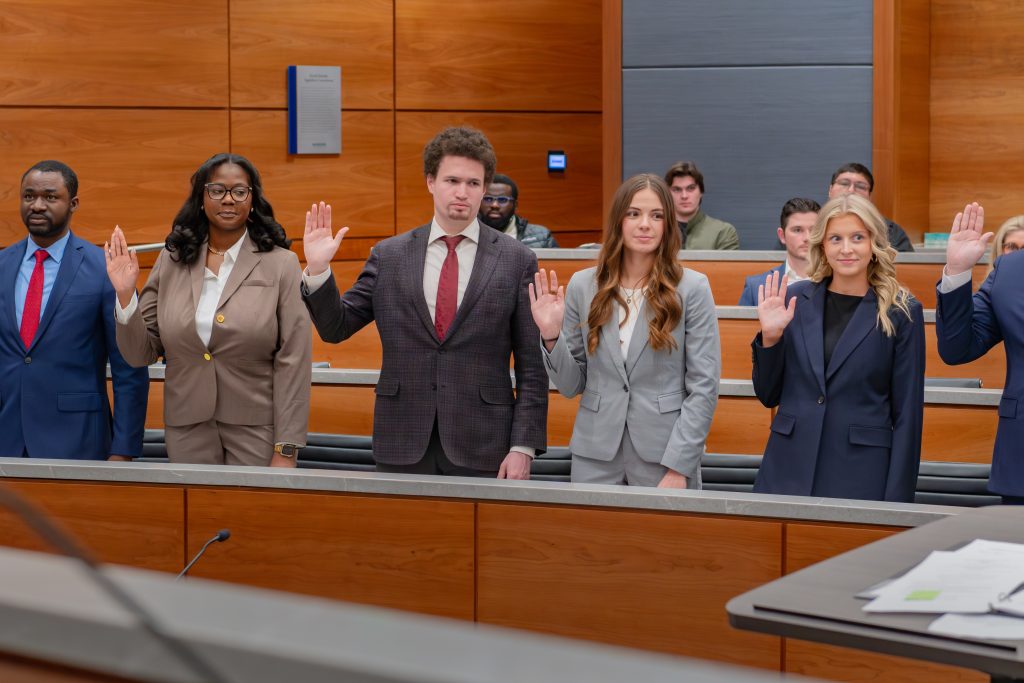
Students, who must complete the equivalent of three semesters’ worth of work toward their law degree to participate in clinic, handle cases from start to finish. They are sworn in by a judge and are authorized to practice under the guidance of an attorney, in this case, Ewert and other clinic faculty.
At January’s swearing-in ceremony, Kansas Chief Justice Eric Rosen presided over the event, and his speech set the tone for the responsibility interns pledge to take on for their clients.
Recalling his immigrant great-grandmother’s experience of taking the U.S. citizen test after fleeing the tyrannist government in Russia, Rosen, jd ’84, told the story of his “bubbe’s” inquiry in front of the court. Despite studying fervently, her nerves caused her to answer questions incorrectly, emotions relatable to many of the clients who turn to the clinic.
“Regardless of what area of law you practice, your clients all come to you feeling very much like my great-grandmother,” Rosen said during his speech. “They are entering a world in which they feel foreign, powerless and – except for you – alone.”
Paul, a first generation Haitian American, said her family’s experience as new immigrants is part of what drove her to go to law school.
Paul’s parents emigrated to escape persecution. When they tried to get green cards, their attorney didn’t show at their court date, leaving them to defend their case with the little English they knew. Despite being a no-show, the attorney still tried to demand payment from Paul’s parents.
“There are so many people who depend on attorneys to advocate for them, interpret the law, and help them in spaces that are unknown to them,” Paul said. “It’s already a barrier for someone who’s born here to navigate the legal system. It’s 10 times more difficult when you don’t speak English.”
Along with client representation, the Washburn Law Clinic’s services also include providing educational programming that helps the community understand their rights and the legal resources available to them. Past programs include presentations on starting a small business, training for parents of children with developmental disabilities wondering what happens when their child turns 18 and criminal record expungement presentations for the Topeka workforce program to help caseworkers and those with criminal records learn how to clear records to more easily obtain employment.
“What we do brings dignity to people,” Ewert said. “Our services help people navigate a complicated legal system in a way that helps them best accomplish their goals.”
Over spring break, Harrison, Paul and fellow intern Donald Ables went to Garden City, Kansas, and helped prepare powers of attorney and expungement paperwork.
They used interpreters in several languages, and Paul was pleased to learn one of the groups they would be assisting is the city’s Haitian population. She was able to translate for them.
“Having the experience of translating Haitian Creole in past jobs, I know the sense of relief that comes when you see someone who not only looks like you, but speaks your language,” Paul said. “There’s an immediate sense of familiarity.”
Some student interns, like Harrison, come to the clinic to gain experience in the area of law they want to practice after graduation.
“I know civil litigation is what I want to do,” Harrison said. “That gives me the drive to go a little bit harder while I’m in clinic.”
Harrison, an Army veteran who previously oversaw signal and command for a general support aviation battalion as a signal officer, said his time in the military equipped him for the types of challenges he’s faced in both the classroom and the Washburn Law Clinic.
“I joined the military hoping to get a bit of life experience and some maturity,” Harrison said. “I think that helped me understand and analyze the problems that you face in law school.”
Harrison was also drawn to the clinic for the impact he could have on a personal level.
“I enjoy being able to make a hands-on impact on individual lives,” he said. “It’s inspiring to put the experiences and knowledge from law school to use – not to make me look good, but to affect and change lives.”
For others, participating in the clinic guides them in a new direction.
“Sometimes, students come in not sure what they want to do, and they fall in love with a particular practice area and that ends up directing their career trajectory,” Ewert said. “It’s a great way to find out what you enjoy.”
For Paul, who can see herself practicing in any area of the law, clinic is a way of setting the foundation for her ultimate career goal: guiding people through the complexities of the legal system. One of her clinic cases, a man looking to have his cases expunged, illustrated the impact Paul hopes to have throughout her career.
“That individual just wants to show society and his grandchildren that he’s a changed person. It’s fulfilling to help someone restore himself,” Paul said. “That’s what I’m looking for post law school. I want to stand in the gap for those who can’t advocate for themselves.”
Whatever the case type, Washburn Law Clinic continues to have far-reaching impacts.
“I am so proud of the work our students do in the community,” Ewert said. “There are a lot of people in and around Topeka whose lives are better because of the legal services our students provide.”
