

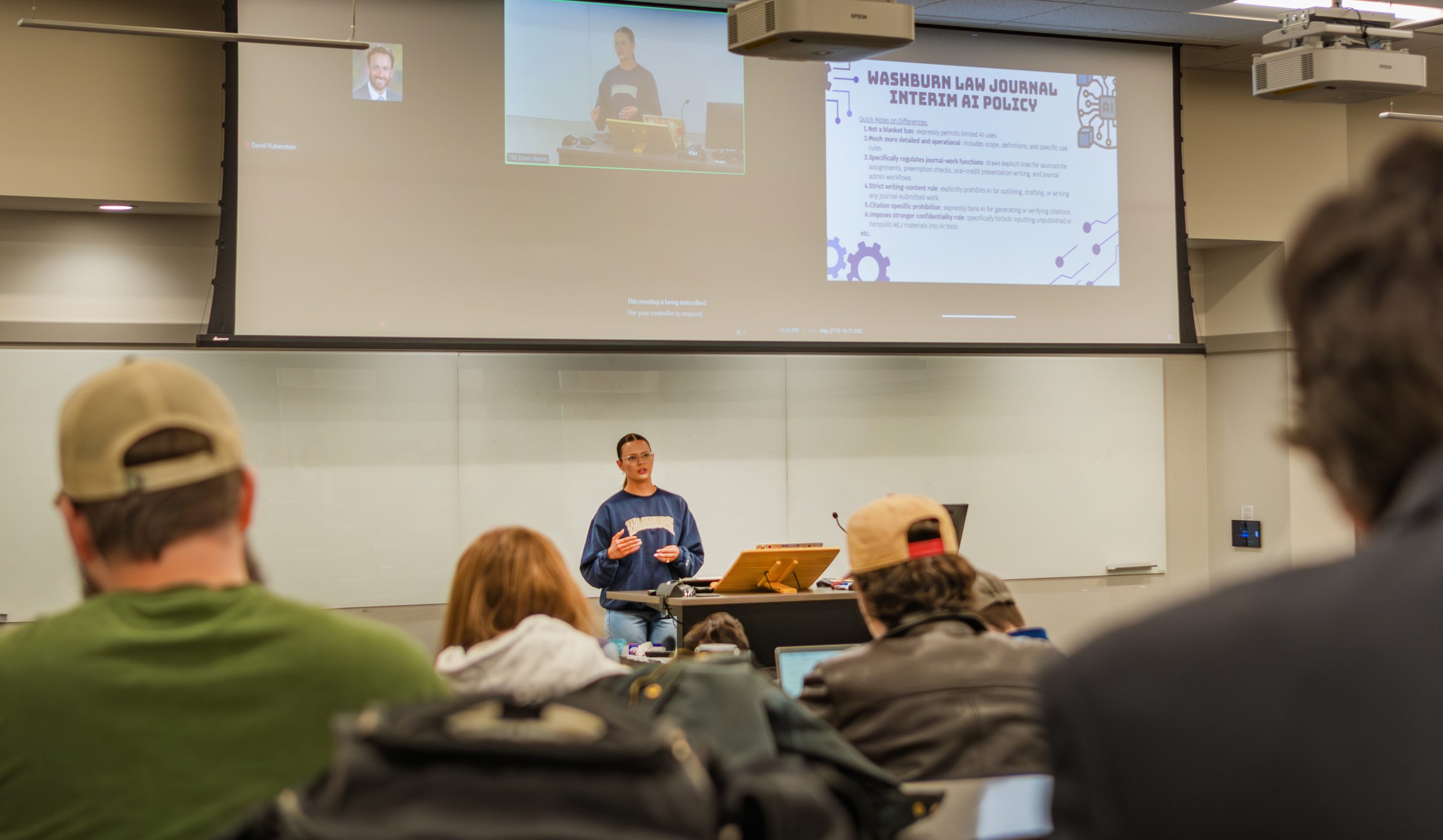
When Lauren Peterson started at Washburn University School of Law in 2023, no one knew how much the legal profession was about to change. That was when ChatGPT became publicly available, and suddenly artificial intelligence entered the national conversation. The technology’s uncanny ability to instantly generate text and images, search for information and brainstorm ideas brought a litany of new ethical, pedagogical and philosophical questions for legal education.
“The birth of ChatGPT started the conversation about how law school is going to evolve,” Peterson said. “A lot of professors are very adaptive and care about the students far beyond law school. Professors began changing the way they teach based on AI awareness.”
In response to student interest, Peterson founded the AI Law Association in March of 2025. As a student-run organization, Peterson says the board has largely focused on AI competency and the impact on legal education and the profession as a whole. This has included guidance from faculty advisor David Rubenstein, James R. Ahrens Chair in Constitutional Law, who teaches a course on AI and has conducted extensive research on the subject. He recognizes that using this technology is becoming an essential skill in the legal field.
“Law firms are coming around to the fact that this is the future – it’s not going away,” Rubenstein said. “I think a lot of people were hoping it might. This is totally reshaping everything in society, and law firms are going to be near the top of the list. Especially as this technology continues to grow, law firms will want to hire people who know how to use it.”
For up-and-coming lawyers, the potential benefits are numerous. According to Jay Knight, Washburn Law associate professor, AI could “revolutionize the workload” of legal research and writing, with the technology able to follow prompts, comb through internal and external legal documents and summarize its findings in a fraction of the time it would take a lawyer to complete the same tasks. However, the technology also presents significant ethical dilemmas regarding privacy, accountability and accuracy.
“AI still makes mistakes – and generative AI in particular can create stuff that isn’t there,” said Knight, who has researched how attorneys can effectively utilize AI. “You have to think of this technology as a very smart assistant. You as the attorney need to supervise that technology. There are over 600 cases where attorneys have been sanctioned because they relied on generative AI to come up with cases that don’t exist.”
To help Washburn students prepare for the future, professors like Rubenstein and Knight are adjusting how they teach, test and structure their assignments to incorporate the growing role of AI. Knight, for instance, will allow students to utilize technology such as ChatGPT or Claude to help with writing and research as long as they acknowledge its role in their finished product.
 “Students can use generative AI throughout the work of the paper, but they cannot have the AI create their paper for them,” he said. “If they use it, they need to submit the prompts they used and the output so I can see what it gave them and what they did with it. In real life, that’s probably the practice that will happen. Their future employers will want them to know how to use generative AI in the workplace.”
Peterson says many students would love to see more AI-focused integration in their classes. She acknowledges that retaining the core competencies of the legal profession is important – but considering most incoming students already use AI in their daily lives, knowing how to ethically use the technology in a professional capacity is also essential.
“We still need to be honing skills such as legal research and writing structures, but the other side of the argument is that we may be building a new skill with integration of AI,” Peterson said. “Some of the older ways of doing things may become obsolete or inefficient in a few years. I hope Washburn Law continues to encourage professors to identify ways to integrate AI into their classrooms where appropriate as the technology continues to exponentially develop.”
Going forward, Rubenstein continues to educate faculty and students on how to use AI tools and their potential pitfalls, as well as develop university-wide policies to guide its use as a member of Washburn University’s AI Working Group. Ultimately, he says it’s his job as a professor to make sure his students are prepared for the real world, and that includes navigating the AI landscape.
“There’s a lot of anxiety and insecurity about what AI means for the future,” he said. “Some people are enthused about it while others are terrified. It’s an unprecedented amount of change all at once, and there is no rulebook. The answer is not to avoid the technology and pretend it doesn’t exist, because the world will go on with it – especially for lawyers. As a teacher, I try to make a difference in the world and educate people so they can thrive in it.”
