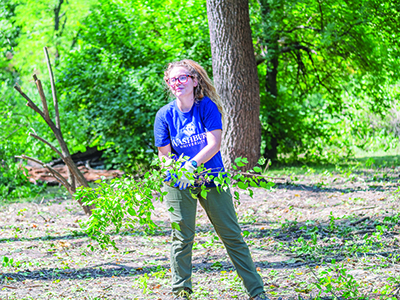

Humans toiled away for several hours on a Saturday this fall, cutting, pulling and digging away invasive plants to clear a plot of forest. Creatures nearby were chomping away at similar growth.
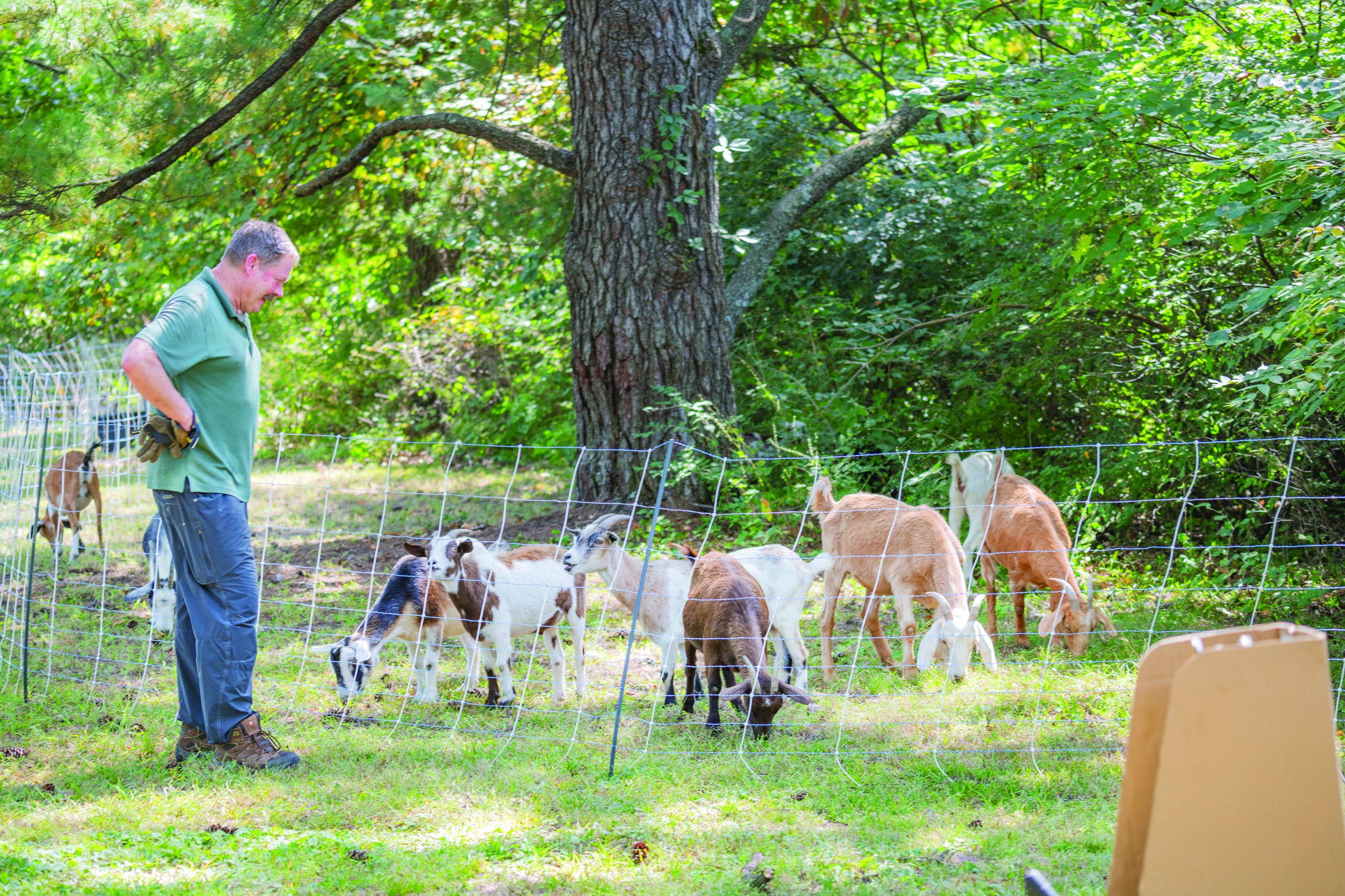
“I like hearing the popping and cracking,” said John Mullican, professor and chair of Washburn’s biology department.
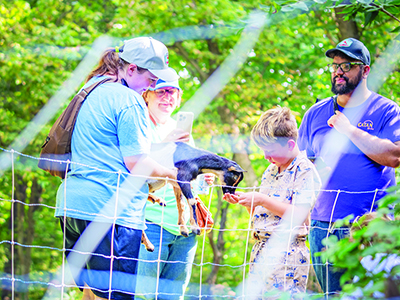
He was referring to the sound of goats biting at branches, twigs and leaves growing up from the forest floor in a fenced-off plot nearby. Thanks to donor support, the department was able to rent the creatures known for their ability to quickly and efficiently clear land of unwanted growth.
Long after the humans – biology students, faculty, staff and volunteers – finish for the day, the goats will stick around and continue their work. For several weeks this fall, the biology department rented the goats to clear invasive growth at Karyle Woods, the department’s field station north of the Kansas River. The main culprit was honeysuckle.
“The problem is that it outcompetes our native plants, said Kaylyn Hobelman, bs ’15, biology department lab supervisor. “If you look underneath the honeysuckle, the biodiversity is just devastated. It’s all bare dirt. So that limits the amount we can use our field station for classes like ecology, entomology and botany. One of our big goals is to get some of this cleared to bring back the biodiversity.”
She mentioned professors Jason Emry, who brings his Plant Systematics class to Karlyle Woods every summer and Rodrigo Mercader, who brings his entomology classes out to study insect life. A fresh chance for the forest floor to grow something besides honeysuckle will benefit students in these classes.
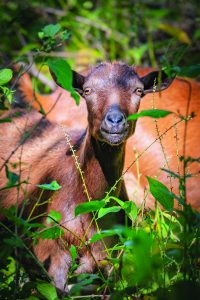
“Increasing the biodiversity of plants also increases the biodiversity of insects,” Hobelman said.
Hobelman was working on a project with the Washburn University Turtle Research Team several years ago to clear poison ivy from land where they were studying box turtles. She looked into ways to avoid touching the unwanted plant.
“One of the things that came up was brush goats,” she said. “So we got a team of about 50 brush goats, and it was truly mind blowing to me how well they cleared that area.”
At Karlyle Woods, the Biology Club, the caretakers and others work every year to clear what they can, but the department was looking for ways to make a bigger impact on invasive species. The idea of goats came up again. A team was rented from a local company for this fall and again next year.
“From there, we’ll see how often we want them to come back to work on these plots,” Hobelman said. “A few small groups of people are not enough to keep up with the rate of growth and expansion of the honeysuckle.”
The biology department has been able to do things like rent goats, purchase tools and host an open house on volunteer days because of a steady stream of gifts from donors. Day of Giving, annual giving and endowments established by donors all help with this and other projects, like the native plant garden outside Stoffer Science Hall and the turtle research. Along with her lab duties, Hobelman works with the Biology Club and EcoBods Club. They always have plenty of great ideas, and she’s thankful for donor funds to help implement them.
“When you want to try new things and have growth and have bigger projects come to life, you obviously need funds,” she said. “There are things we couldn’t do without donor support.”