

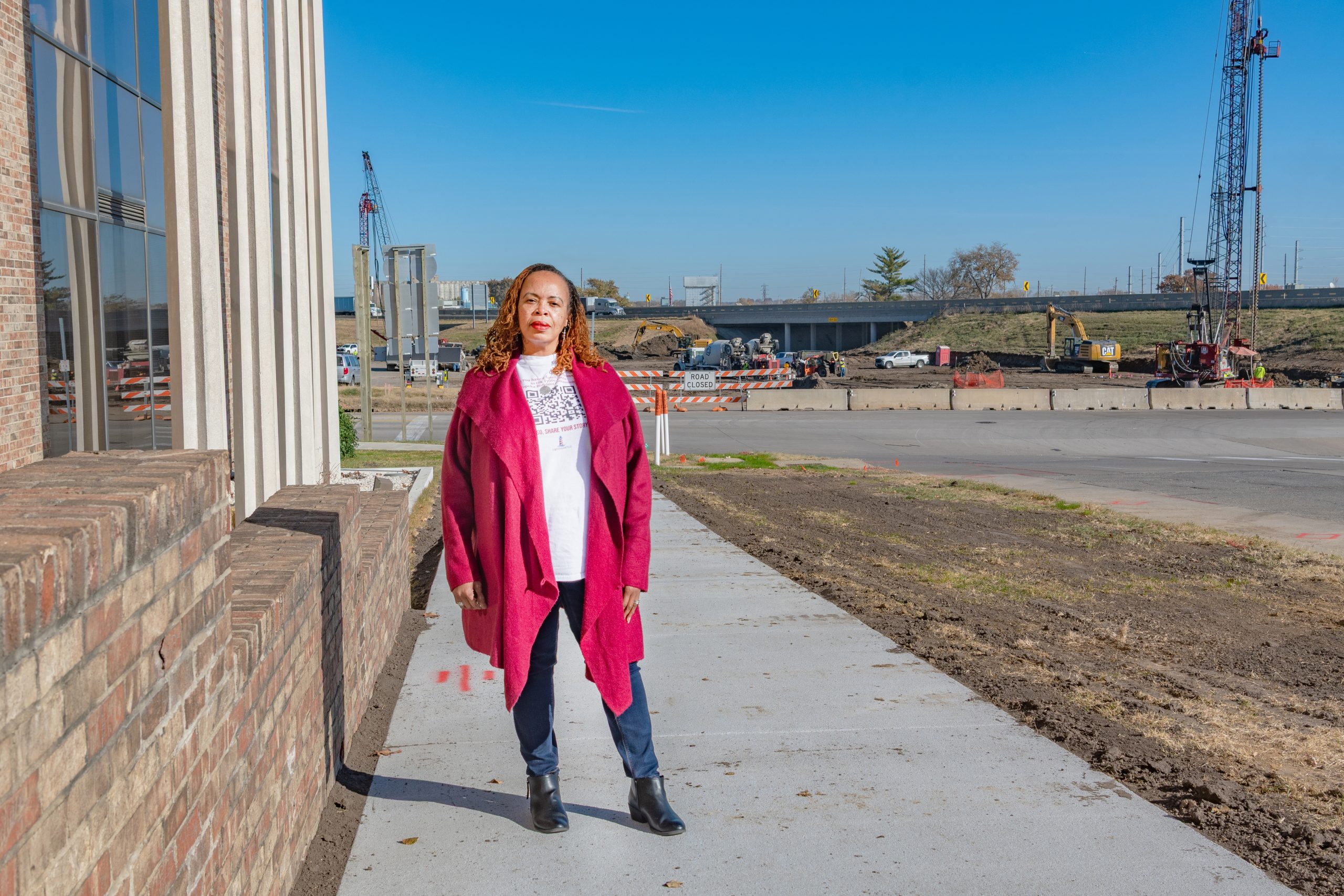
Tara Wallace stands at SE 4th and Monroe Streets with construction on Interstate 70 taking place behind her. She did research to study the effects urban renewal has on the people it displaces, as the I-70 project did in the 1960s when this section was first built.
From The Ichabod – Winter 2026
Story by Samantha Marshall | Photos by Jeremy Wangler
Tara Wallace wants to work herself out of a job. A clinical social worker and founder of a non-profit organization, Wallace, msw ’13, has focused her career on supporting underserved areas of Topeka.
After learning about the Polk-Quincy Viaduct – a 1960s highway project that uprooted residents and business owners – Wallace’s work took on a new purpose. Perceiving the trauma that continues to burden the community and their families, Wallace began gathering research in hopes of demonstrating the psychological impacts of such projects.
Wallace’s work is timely, as the same stretch of highway is now under reconstruction, forcing businesses to relocate. Calling on her Washburn education and connections to guide her, Wallace hopes to provide Kansas lawmakers with meaningful data about the human side of urban renewal.
Wallace traces her roots in social work to the women who raised her.
“My mom did social service work. My grandmother and stepmom did the same thing, even if it wasn’t part of their careers” Wallace said. “I’ve been exposed to helping and advocating for others my entire life.”
Wallace got the idea to pursue her master’s degree while sitting beside her mother, who was undergoing chemotherapy. Noticing Wallace’s sociology homework, a hospital social worker struck up a conversation and encouraged her to apply to Washburn, where her husband was a professor of social work. Wallace’s mother was also enthusiastic. A year later, Wallace started at Washburn, just a few months before her mother’s death from cancer.
“I learned so much through grad school,” Wallace said. “I met some amazing people who I still connect with.”
One connection is Norma Juma, Brenneman Professor of Business Strategy, who mentored Wallace both in and out of school.
“Norma recognizes how the stories told by data can be overlooked and works hard to give voice to them,” Wallace said.
Wallace said Juma shaped the way she thought about research – a concept that would become pivotal in Wallace’s future work.
“I believe everything we do should be evidence driven,” Juma said. “That’s the beauty of what we do as researchers. We can aggregate various voices and say, ‘This is a story the data is telling us.’”
After graduating, Wallace established a career in private practice, working primarily with children. Through that work, Wallace saw there were needs even she could not address due to lack of resources.
“A lot of families are stretched to their limits,” Wallace said. “They’re exhausted and they need an extra shoulder to lean on.”
Wallace formed her non-profit organization, Lighthouse Therapeutic Community Outreach Foundation to address community needs she saw through her clients. Her outreach often takes the form of programming, from yoga for kids to a back-to-school event called Backpacks, Barbers, and Braids.
Wallace had a lightbulb moment when she visited the Brown v. Board of Education National Historical Park with her Leadership Greater Topeka class. While learning about the Polk-Quincy Viaduct, the project that built the stretch of Interstate 70 through downtown Topeka, Wallace instantly saw a connection between her clients and their families who were displaced by the project.
“These individuals were uprooted from everything they knew,” Wallace said. “I thought, ‘Maybe that’s why there’s this sense of helplessness and disconnect.’”
Wallace learned as much as she could about the Polk-Quincy Viaduct and reached out to researchers who study redlining. She soon discovered there has never been a study that addresses highway trauma and its generational impact from a physiological or sociological perspective.
Wallace put a team in place in April 2025 and began collecting surveys of those affected by the 1960s construction project. Their goal is to gather 1,200 responses.
“This is an opportunity to give information to our state so we can understand how to better serve people who are struggling,” Wallace said. “We can address symptoms all day, every day, but if we don’t get at the root cause, we’re never going to shift.”
Juma said Wallace’s work is crucial in giving a voice to those who are not present when decisions are made.
“To have people willing to work among the underserved and reflect those voices is extremely important,” Juma said. “Tara stands out because she lives among these people and represents them where policy is informed.”
For Wallace, success would mean empowering people to advocate for themselves.
“My goal is to not be focused on the same problems in five years,” Wallce said. “I want to be so good at empowering people and showing them their greatness that we have to shift our mission in order to be relevant.”
1700 SW College Ave., Topeka, KS 66621
785.670.4483
contactus@wualumni.org
Copyrights © 2026 Washburn University Alumni Association and Foundation. All rights reserved. Privacy Policy
