

The Distinguished Service Award is bestowed on graduates of the School of Law who have particularly distinguished themselves and brought recognition to the school through their service to Washburn University School of Law, the legal profession, their community, or public service.
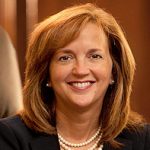 The Honorable Nancy L. Moritz was born in Beloit, Kansas, on March 3, 1960. She grew up in a big family in the small community of Tipton, Kansas. Her family moved to Salina, Kansas, when she was 15.
Judge Moritz received her BBA from Washburn University in 1982 and her J.D. from Washburn University School of Law in 1985, where she served as the Notes Editor of the Washburn Law Journal.
Judge Moritz currently serves on the U.S. Court of Appeals for the Tenth Circuit. The Tenth Circuit, based in Denver, Colorado, reviews legal cases from Kansas, Colorado, New Mexico, Oklahoma, Utah, and Wyoming.
In 2004 Judge Moritz was appointed by Governor Kathleen Sebelius to the Kansas Court of Appeals and served on that court until 2010, when Governor Mark Parkinson appointed her to the Kansas Supreme Court.
Prior to her appointment on the Court of Appeals, Judge Moritz served as a Research Attorney from 1985 to 1987 to Kansas Supreme Court Justice Harold S. Herd. She then served as a law clerk to Judge Patrick F. Kelly with the United States District Court in Wichita, Kansas.
From 1989 to 1995, Judge Moritz was an associate with Spencer Fane Britt and Browne, in Overland Park, Kansas and Kansas City, Missouri, where she handled defensive matters and specialized in employment litigation.
She returned to public service in 1995 when she became an Assistant United States Attorney in Kansas City, Kansas. She worked in the Civil Division of that office in Kansas City and later in Topeka until 1999, when she became the Appellate Coordinator for the United States Attorney’s office, a position she held until her appointment to the Kansas Court of Appeals.
Judge Moritz served for nearly two decades on the Board of Editors of the Journal of the Kansas Bar Association and was the first woman to chair that Board. She has also served on the Kansas Continuing Legal Education Commission, the Tenth Circuit Advisory Committee, and the Board of Governors of Washburn University School of Law.
She has written and published several legal articles and has been a frequent presenter at CLE programs statewide. She continues to be an active member of the Kansas Bar Association and other professional and community organizations.
The Lifetime Achievement Award is bestowed on graduates whose careers have been highly distinguished, and whose achievements and contributions are widely recognized as significant and outstanding in their field of endeavor, whether it be in the practice of law, the judiciary, business, public service, education, or otherwise.
 Kay Arvin grew up on in 1920’s Kansas on a working farm. At 3 years old, she followed her sister to a 1-room schoolhouse near Cullison, Kan. Blessed with an enlightened teacher, Kay was given a desk and invited to listen. Thus began a life of engaged learning that never faltered.
In 1942, while a student at Ottawa University in northeast Kansas, Kay met Les Arvin at a Valentine’s Day dance. They fell in love that night, but World War II delayed their marriage until 1944. Love prevailed however, when Les, stationed in Honolulu with a communications unit, conspired to get Kay a job on the island with the War Department. The plan required Kay to hide her wedding bands by sewing them in the shoulder of a dress, and for the couple to pretend to meet in Honolulu as though strangers. The 2 were eventually married in a local Hawaiian church overlooking the Pacific Ocean.
Shortly after the war, Kay was blinded by an accident. Unwilling to remain captive in their small apartment, Kay inquired if she could accompany Les to his classes at Washburn, where Les was enrolled in law school. When faculty agreed, Kay quickly discovered her own fascination with the law. She enrolled and thrived at Washburn, serving as Secretary for the Washburn Bar Association.
After graduation, Les and Kay became Wichita attorneys and raised their 2 sons near Rose Hill. Les Arvin also served as a state legislator. In spite of the challenges of blindness, Kay embraced the dual roles of mother and working professional. Kay’s practice specialized in adoption and divorce, and later, in mediation. Her book on marriage, 1+1=1, was published by Broadman Press in 1969. Kay was an in-demand speaker on marriage and Christian faith, and considered her legal career an extension of her commitment to helping others.
Kay was skeptical of the term “feminist”, but quietly embraced what she considered the best of the movement’s ideals. She championed the cause of abused women, interviewed several women incarcerated for killing abusive husbands, and advocated for their behalf with then-Governor Joan Finney. She was the first woman to try a case in her state’s Supreme Court and win. She was listed in Harvard’s Best Lawyers in America.
Kay broke ground for Kansas women in the legal profession. She was appointed in 1978 to fill out a four-month term as a judge in Sedgwick County, and although she made clear she had no desire to run for election beyond the term, became one of the first female judges in the state. Among many other appointments, Kay served on the Kansas Racing Commission.
Kay considered civic and pro bono work an obligation. She served on the boards of many organizations, and was a founding board member of ENVISION, a Kansas-based nonprofit dedicated to improving the lives of the vision-impaired. Among her many awards is the National Brotherhood Award from the National Association of Christians and Jews. She was a Lifetime Trustee of her alma mater, Ottawa University, where a scholarship in the name of Les and Kay Arvin is established.
Kay traveled the world, including a trip to the former Soviet Union to study their legal system. She and Les taught a class in legal principles in Singapore. In addition, Kay was an award-winning sculptor in both wood and clay. Her pieces astonished those unaware that she worked in total darkness.
“She was such a woman of courage,” said Sally Dewey, a former Wichita City Council member. “She was one of my heroes.”
Nola Foulston, the former Sedgwick County district attorney, recalled how she would announce her name whenever she and Mrs. Arvin ran into each other in the courthouse.
“Kay was a phenomenal, lovely woman,” Foulston said. “She was able to go to law school while blind. There weren’t many women in the (Wichita) bar at the time, probably fewer than 10.
Arvin’s sister-in-law, Ernestine Krehbiel shared: “Kay was an inspiration to me…She never, never complained about being blind or that she couldn’t do this or that.”
In 2001, Kay and Les Arvin moved to Nashville to be closer to family.
Mrs. Arvin died June 1, 2014 in Nashville, Tennessee, six days before her 92nd birthday.
The Lifetime Achievement Award is bestowed on graduates whose careers have been highly distinguished, and whose achievements and contributions are widely recognized as significant and outstanding in their field of endeavor, whether it be in the practice of law, the judiciary, business, public service, education, or otherwise.
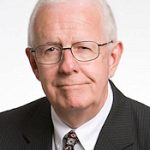 Winton M. Hinkle was born in Hays, Kansas on March 2, 1942, and grew up in Garden City, Kansas. He received his B.S.E. cum laude in English from Emporia State University in 1964. He earned his J.D. degree magna cum laude from the Washburn University School of Law in 1968. Hinkle was a member of Phi Alpha Delta and Editor-in-Chief of the Washburn Law Journal.
In December 2014 Hinkle retired from Hinkle Law Firm LLC, a company he founded in 1987. He was Senior Counsel, concentrating his practice in municipal finance and securities law. The Hinkle Law Firm currently has 40 attorneys, and more than 70 support staff, including paralegals and accountants, representing private and publicly held businesses.
Hinkle served as Chief Legal Counsel for the Kansas Chamber of Commerce from July 2005 to 2013. He also served on the Chamber’s Board of Directors and as an ex officio member of the Executive Committee.
He was named a Fellow of the American College of Bond Counsel (ACBC). Hinkle is the only Wichita attorney to achieve the prestigious status of Fellow, and is one of a handful of ACBA Fellows in Kansas. Membership in the ACBC is limited to those attorneys with at least 10 years of substantial experience in bond law, and nomination as a Fellow is a peer recognition for the lawyer’s accomplishments and expertise in the area of public finance law.
Hinkle is a member of the American, Kansas, and Wichita bar associations; National Association of Bond Lawyers; and was a member of the New York Stock Exchange Arbitration Panel from 1988 to 2013.
He is admitted to practice before the United States Court of Appeals, Tenth Circuit and U.S. District Court, District of Kansas.
Hinkle’s many contributions to Washburn Law School include:
Hinkle and his wife established an endowed unrestricted program fund in the Business and Transactional Law Center during the Centennial Celebration. The Hinkle Elkouri Law Firm, L.L.C. established a $50,000 scholarship at Washburn Law during the Centennial. The firm also makes cash awards to Washburn students in the National Negotiation Competition.
Winton and his wife Pauletta have four adult children.
The Lifetime Achievement Award is bestowed on graduates whose careers have been highly distinguished, and whose achievements and contributions are widely recognized as significant and outstanding in their field of endeavor, whether it be in the practice of law, the judiciary, business, public service, education, or otherwise.
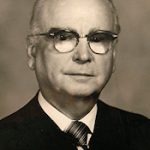 The Honorable Alexander A. Hotchkiss was born in Burlingame, Kansas on August 12, 1904. He was born of naturalized, immigrant parents from Scotland and his father was a coal miner in Osage County, Kansas.
After grading from Washburn University School of Law in 1927, Judge Hotchkiss moved to Lyndon, Kansas in Osage County to practice law and run for County Attorney. He later returned to Topeka to accept a legal position with the then Oil Department of Kansas. While in Topeka, Judge Hotchkiss met Mary Van Tries, a teacher in the Topeka school district. They were married on June 16, 1933 and shortly thereafter moved to Lyndon where Hotchkiss practiced general law. While in Lyndon, Hotchkiss ran for County Attorney and in 1943 was elected to the Kansas Senate.
In 1960, Judge Hotchkiss became judge of the Fourth Judicial District, encompassing Osage and Wabaunsee counties. Judge Hotchkiss was also called on occasion by the Kansas Supreme Court to preside over cases throughout the state. He was appointed to hear the 1965 appeal of Richard Hickock and Perry Smith, on the convicted murders of four members of the Clutter family, in the Finney County District Court in Garden City, Kansas.
Judge Hotchkiss was a leader in progressive legal reform. As a member of the Kansas Judicial Council, he made significant contributions to the judicial system in his committee work. Judge Hotchkiss was one of the early moving forces behind the publication of the “Pattern Instructions for Kansas,” available to judges and lawyers in both civil and criminal cases, and providing clarity and instructions for jurors in the courtroom.
Judge Hotchkiss served as Washburn Law Alumni Association President from 1954 to 1955. He was awarded the Distinguished Service Award from Washburn University School of Law in 1967.
In addition, Judge Hotchkiss was a mentor to law students and young lawyers. He was devoted in preparing them for the bar examination. The Washburn Chapter of Phi Alpha Delta renamed itself after Judge Hotchkiss in tribute for his many hours of service. Judge Hotchkiss served as justice of the national fraternity in 1967, and later was appointed Supreme Justice of Phi Alpha Delta Legal Fraternity, International. He offered a bar review course exclusively for Benson Chapter members at no cost because he was a devoted P.A.D. His several one-man shows around the country were quite uncommon. He started the review the year his son Bruce graduated from Washburn Law, driving from Lyndon, Kansas to teach in the library in the attic of the P.A.D. house at 1612 College. In later years, graduates drove to Lyndon and the Judge lectured for several hours each afternoon in the non-air conditional Osage County Courthouse. The success rate on the bar exam for those completing this course was unsurpassed. Judge Hotchkiss became known as the “Oracle of Lyndon.”
Judge Hotchkiss was recognized as having an outstanding legal mind and was considered one of the best district judges in the state. He was highly regarded among his colleagues and his community as a fair and impartial judge who followed the law.
In remembering Judge Hotchkiss, The Honorable George Templar of the U.S. District Court of Kansas, a close friend, commented: “Judge Hotchkiss was, without doubt, one of the ablest trial judges in the state…He seemed at his best with a jury in the box and a counsel table filled with able trial lawyers. Those who watched him at such times realized that here was a trial judge who believed that every man, no matter what the dispute, was entitled to his full day in court and he saw to it that the day in court included fairness, impartiality and dignity.”
Another close friend, The Honorable Harold Fatzer, Chief Justice of the Kansas Supreme Court, made the following statement: “It is commonly understood the deeds of great men survive them. Such is the case with Judge Alex Hotchkiss – his deeds will live on…The impression he made upon the jurisprudence of this state will be lasting.”
Judge Hotchkiss passed away on May 9, 1973.
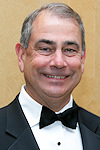 George Barton grew up in Kansas City, Missouri. He received a Bachelor of Arts degree from the University of Pennsylvania in 1973 and his Juris Doctor degree magna cum laude from Washburn Law in 1977. Barton has practiced law in Kansas City for 38 years, focusing in civil litigation.
Since 1998, Barton has been principal in the Law Offices of George A. Barton, P.C., which specializes in complex business litigation. During that time, he has devoted the majority of his practice to representing mineral interest owners in royalty underpayment litigation against natural gas producers in Colorado, Kansas, and Oklahoma.
During the last 10 years, Barton has been a frequent guest lecturer to Washburn Law students on various topics related to the preparation and trial of business litigation cases. In 2011, he was the recipient of the Washburn Law Alumni Association’s Distinguished Service Award, which is bestowed upon Law School graduates whose careers have been highly distinguished, and whose achievements are recognized as significant in their field of endeavor. Barton is also a member of the Washburn University Foundation Board of Directors.
Barton has two children and one grandchild. He and his wife, Theresa, live in Mission Hills, Kan.
The Honorary Life Membership Award honors someone who has provided exemplary service to his or her profession, community, and Washburn University School of Law.
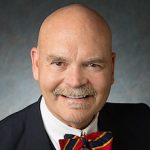 David J. Rebein is founder and partner of Rebein Bangerter Rebein. He received his B.A., summa cum laude, in Political Science from Washburn University in 1977. While at Washburn, Rebein was inducted into the Phi Kappa Phi Honor Society. Rebein earned his J.D. from the University of Kansas Law School in 1980.
Rebein is a member of the American College of Trial Lawyers. He is a past president of the Kansas Bar Association and past president of the Legacy for Justice Foundation. Rebein is current treasurer of the Kansas Association for Justice. He is admitted to the Kansas and Florida bars.
Rebein received the 2009 Distinguished Service Award from the Kansas Bar Association for continuous longstanding service on behalf of the legal profession.
Rebein has been recognized by Best Lawyers in America and Super Lawyers for his work as a trial lawyer.
With more than 30 years experience, Rebein has tried hundreds of cases and represented Fortune 500 Companies as well as individuals in commercial and personal injury cases. He is at home in both Federal and state courts. Rebein sums up his work in saying, “I walk into a tragedy and try to make sense of what happened. I personally investigate the case and if I take it, I give it everything I’ve got.”
